It's often a bigger challenge to communicate with the parent than with the child patient, says pediatrician Václav Koucký

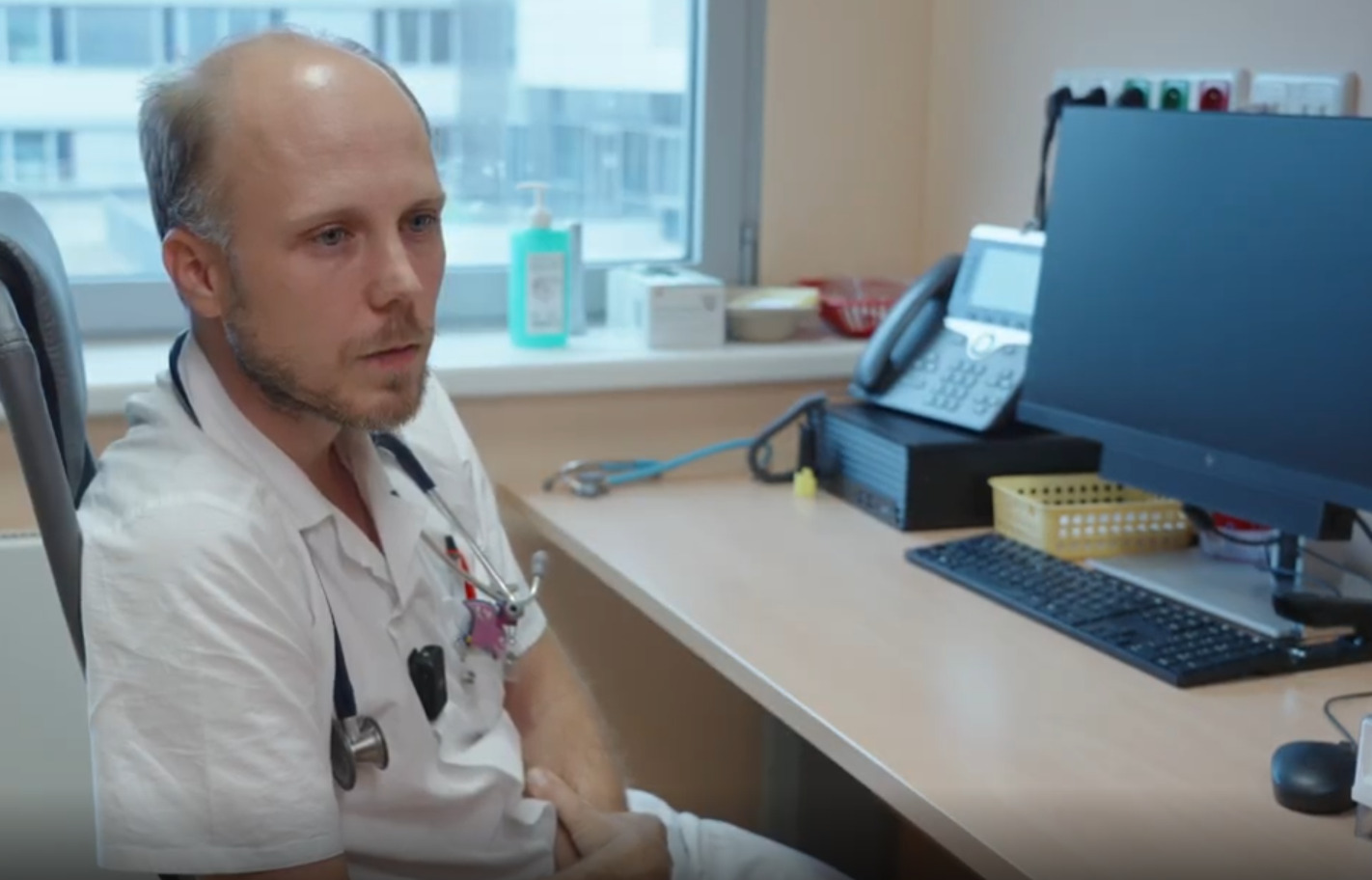
Doctor Václav Koucký specializes in pulmonary diseases at the Bulovka University Hospital. In an interview, he revealed what makes treating children specific and why he decided to become a pediatrician. How long can it take for the lungs of extremely premature babies to mature? What is the most challenging aspect of treating infants? And has he ever saved someone's life?
What is the most challenging aspect of treating infants? And why is the need for oxygen support often most significant during sleep or feeding?
It is challenging for children when they require greater support because breathing is naturally suppressed during sleep. So this is where immaturity of the respiratory tract and the need for oxygen support can manifest.
And how do doctors even know that a child can already manage breathing with less support? And what must they be able to do before being discharged from the hospital?

When children are hospitalized, it is often in the intensive care unit, then in the intermediate care unit, where they are intensively monitored.
There, their oxygen saturation is measured continuously and we regularly examine whether we can reduce the support. This means that we try to give them less and less oxygen and perhaps even discontinue it for a period of time and see how the child manages. Whether they are short of breath, whether they maintain those saturations.
This is done at regular intervals and before discharge we should be certain that parents are able to recognize situations when the child needs oxygen support. And that's exactly what the home oximeter is for, which objectively shows them their condition. They put it on the foot or finger, measure it and have information about what the saturation level should be.
Usually it's at 93% and according to that they can then manage the oxygen therapy. It's also very important in that we said at the beginning that oxygen is indeed a medicine, but at the same time it also has certain toxic effects if it were administered unnecessarily or in high doses. And that's why we try to find the optimal intensity of treatment – so that it suits the particular child.
And furthermore, there is also the fact that as the child grows, their functional reserves can naturally increase. So we expect that the oxygen requirement will also decrease. Therefore, when parents have an oximeter at home, they can react flexibly and adjust the therapy according to what the child currently requires. For example, when they catch an infection (infection, editor's note), they can increase the support again. When things improve through natural development, they reduce it again.
And how long can it take for the lungs of extremely premature babies to gradually mature and for the need for oxygen support to decrease?
Generally, data shows that most children get rid of oxygen within two years. And again, I would emphasize the dependence on the severity of immaturity. The more immature the child, the more damaged the lungs are, the longer the period during which they need oxygen.
And it is very individual, which is why we conduct regular examinations and monitoring of the condition.
Now I would like to ask you, why did you decide to become a doctor in the first place?
I was always interested in biological sciences and medicine certainly belongs to this field. It is connected with the fact that you can help people. And why did I choose pediatrics, or rather pediatric pulmonology? It combines an internal medicine specialty – that is, we treat using medications and think through diagnoses – but at the same time there are also certain procedures that we are able to perform with our hands – bronchoscopic interventions – so it's a nice combination of internal medicine and, I don't want to say surgical, but at least some manual work.
Do you think that doctors' work in the Czech Republic is sufficiently financially rewarded?
Well, it depends to a large extent from hospital to hospital. The work is certainly demanding, but the remuneration could of course be better. But it's not exactly a tragedy either, that's how I would put it.

As a doctor, do you believe in alternative methods of treatment?
Well, I believe, I don't believe – I rather think that in some situations it can help people.
As a doctor, I should follow what is proven, scientifically documented, and what we can responsibly recommend to people. In the case of alternative medicine, that's not the case, but I don't think that means it can't work. It can certainly help some people, I've encountered many times that, for example, our medical options fell short and something alternative helped those people.
However, it should always be done in a way that patients inform their doctor about it. So that we can be frank about it and so that alternative medicine doesn't interfere with standard treatment. So if it's in consultation with the doctor and doesn't interfere with standard treatment, which we believe is somehow documented to be effective, then I have nothing against it with my patients. But it's not good when the treatment interferes with standard procedure.
Have you ever saved someone's life? And if so, what does it feel like?
Well, that's an interesting question. I probably won't be able to tell you some kind of action story where I pulled someone out of a car or something like that. Fortunately, I haven't had that opportunity.
And I'm glad I haven't found myself in such a situation. But I think that within my profession, from a long-term perspective, we help these people. And perhaps we could even say that it is saving lives.
But it's not something like I pulled a drowning person from the water or from a burning car. Certainly not.
And what is the biggest challenge for you as a doctor?
The specificity of pediatrics, caring for children, is that in many cases we always have to talk with parents and explain the problem to parents in such a way that we ensure their cooperation.
And many times the bigger challenge is to communicate with the parent. To convince parents to do what we think is good for the child and can help them. So it's often easier to communicate with the child patient than with the parent. So that can be such a big challenge for us.
And finally, I would like to ask how you perceive the activities of the Our Lungs Foundation?
I am very glad that we can collaborate, or rather, that you support our patients, who in many cases have very complex diagnoses, serious health conditions, and hand in hand with that comes the social situation in the family. So it is a very beneficial activity and we thank you very much for it.
Source: own survey, Our Lungs