In Serbia, another authoritarian leader failed in the elections. Vučić was swept away by student protests

The hegemon of Serbian politics Aleksandar Vučić, who ruled the country for 14 years, acknowledged his party's defeat in yesterday's early parliamentary elections. According to him, the opposition Student Ticket won, which according to initial estimates could occupy 135 to 140 seats in the 250-member parliament.
Sunday's elections in Serbia were a referendum on the continuation of the long-standing rule of right-wing populist Aleksandar Vučić and his Serbian Progressive Party. His challenger was the Student Candidacy, which emerged from a protest anti-government movement. 6.4 million voters were choosing who would occupy the local 250-member parliament. Vučić's decision to run for prime minister was perceived by experts as a carefully planned maneuver aimed at maintaining his top position and increasing his party's chances.
Revolt of the Young Generation
Early parliamentary elections were held in Serbia after Vučić dissolved parliament in September, called elections and resigned from the post of president. He announced that his ambition is to become the country's prime minister again.
Massive demonstrations against the government of President Aleksandar Vučić have been taking place in the country for almost two years. The main demand of the protest organizers, which attracted hundreds of thousands of people, was the restoration of independence of state institutions and early elections.

Vučić and his right-wing Serbian Progressive Party have been ruling the country for fourteen years. During that time, he has managed to be both president and prime minister for the past twelve years. Domestic and foreign critics accuse him of authoritarian tendencies.
The criticized leader has repeatedly faced accusations of suppressing democratic freedoms while simultaneously allowing organized crime and corruption to flourish, which he denies. Serbia maintains strong ties with Russia and China, but formally also pursues membership in the European Union.
Tension in Serbia has persisted since a newly reconstructed concrete canopy at a railway station in Novi Sad in the north of the country collapsed and killed 16 people. According to critics, corruption in public procurement is to blame. The protests were initially accompanied by violence. Serbian police faced accusations of excessive use of force and arbitrary detention of demonstrators.
Pressure and threats
During the election campaign, public sector employees were pressured to register on a list where they pledged their votes to the Serbian Progressive Party. If they did not do so, they received threats of career advancement being halted or dismissal.
The elections themselves took place in a tense atmosphere and were accompanied by extraordinary interest. The highest number of people came to vote since the breakup of Yugoslavia in 1992. Long queues formed in front of polling stations even before they opened.
Election day was accompanied by a number of reported incidents. In some polling stations, observers registered problems related to pressure on voters, members of electoral commissions or observers. Serbian station N1 reported several violent incidents during the day. In Pančevo, a group of masked men with sticks and flares allegedly attacked several young men in front of a polling station. Near the town of Ruma, according to witnesses, masked men attacked and injured approximately ten motorcyclists.
Two journalists who were reporting on the voting in the village of Pavlovac were also attacked. The European Federation of Journalists subsequently called on Serbian authorities to ensure the safety of journalists and allow them to work without disruption.
A tense situation before the closing of polling stations also prevailed in the center of Belgrade. Local police closed part of Kralja Milana Street around the Republican Electoral Commission, police units were deployed in front of the presidential building, and gendarmerie vehicles designed for interventions against demonstrations also appeared in the streets. Some shops and restaurants in the area preventively covered their windows with wooden boards.
Great interest in voting accompanied the elections abroad as well. There was a long queue not only in front of the Serbian embassy in Prague, but streets in other world cities were also filled, for example.
High turnout favored the Student Ticket
According to the independent Serbian monitoring organization CRTA, voter turnout reached around 67.8 percent at seven o'clock in the evening. The election headquarters of the Student Ticket then estimated turnout at 8 PM at 69.1 percent.
Shortly after eight o'clock, Vučić came forward with a perhaps somewhat surprising statement.
"We still don't have the final results, but based on the sample ... it is clear that we have lost these elections,"
announced the hegemon of Serbian politics.
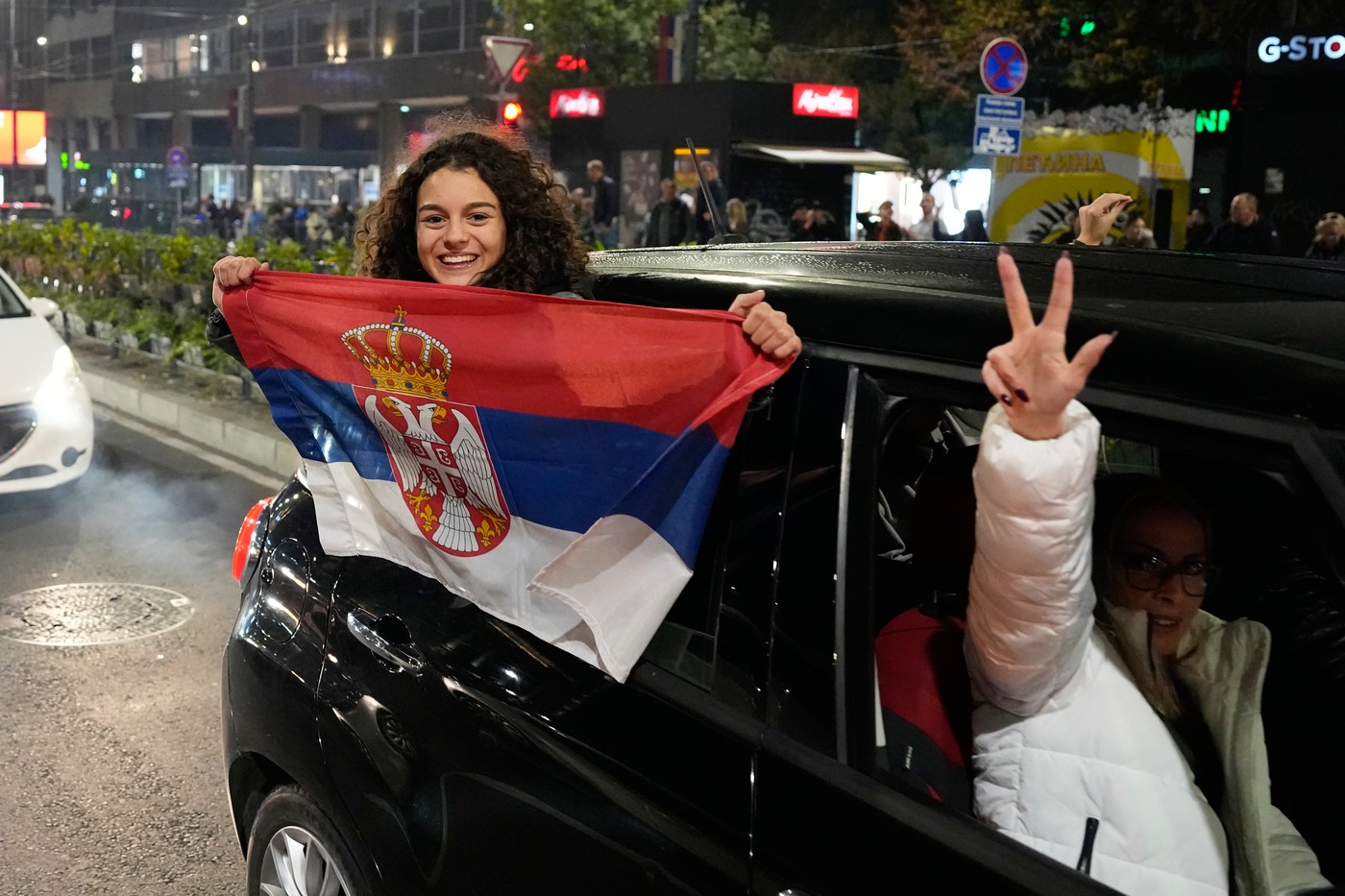
Vučić's announcement triggered an explosion of joy in the streets of Belgrade and other Serbian cities. Cars honked, people hugged each other, sang and danced the traditional Serbian dance kolo.
The Student Candidacy won 52.61 percent of the votes, while the coalition around Vučić's Serbian Progressive Party received 39.24 percent. No other political grouping crossed the threshold for entering parliament, according to data from the electoral commission after counting approximately 97 percent of polling stations.
According to projections by the non-governmental organization CeSID and the IPSOS agency, the Student Candidacy will have 140 mandates in the 250-member assembly, while Vučić's electoral grouping United Serbia will have 103. The remaining seven seats will be divided among parties representing the Hungarian, Bosniak and Albanian minorities.
Sources: author's article, ČTK, Novinky.cz, CRTA