"Laws can't keep up. We don't know who actually owns AI creation," says the lawyer.
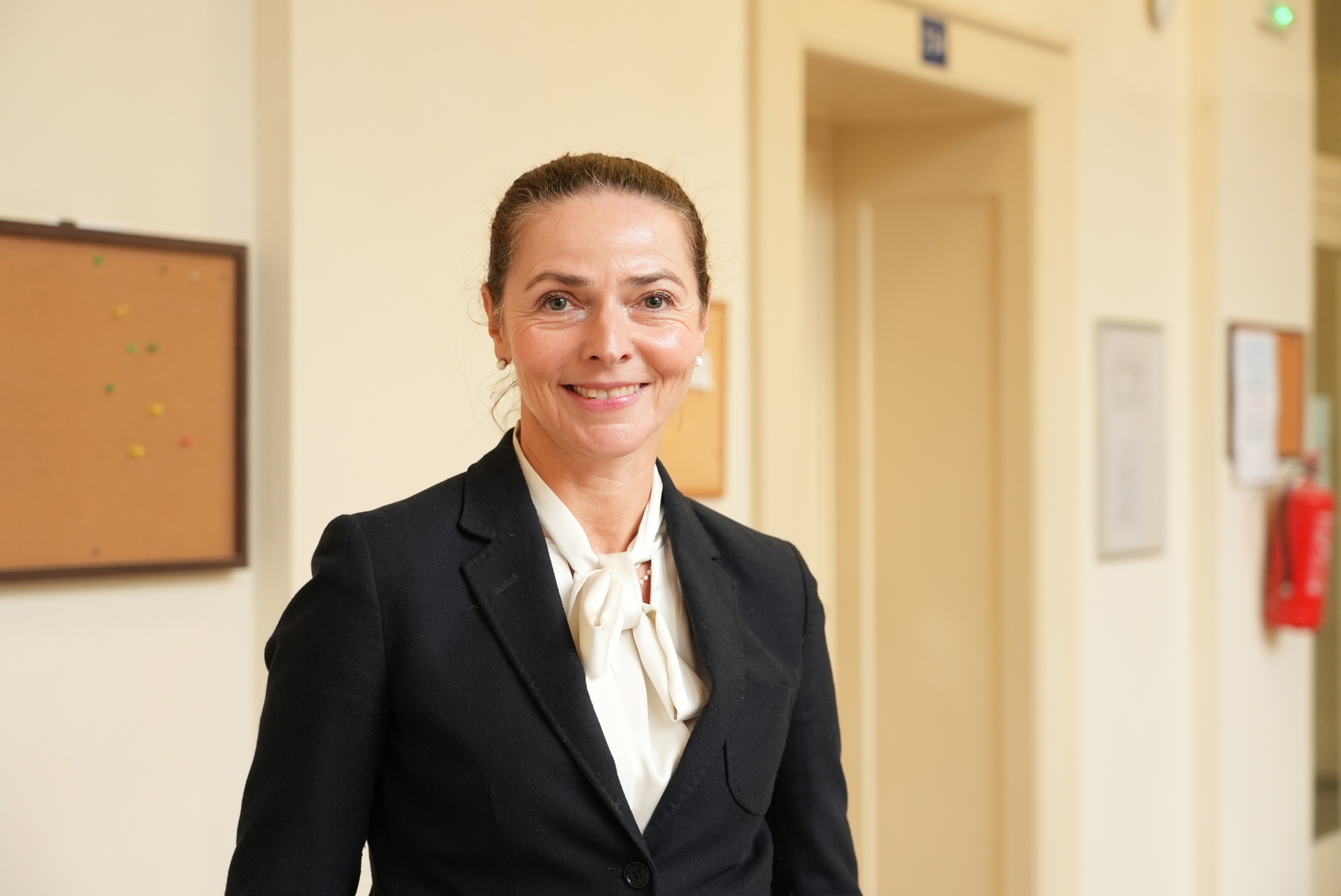
We met at the Faculty of Law of Charles University, where JUDr. Petra Žikovská, Ph.D. teaches copyright law and leads the Center for Intellectual Property Law. At the same time, she acts as the director of the Czech National Group of the International Federation of the Music Industry (ČNS IFPI), so she is close to music and other creative industries not only professionally, but also personally. Today, one of the greatest changes is taking place at the intersection of these two worlds - of paragraphs and arts. Artificial intelligence composes music, writes texts, generates images, and interferes with areas that have until now been exclusively human creativity.
In the interview, she openly talks about how this is changing the understanding of authorship, why the law is not yet keeping up with the pace of technological development, and why she believes that human creativity will remain irreplaceable in the era of algorithms.
Ms. Žikovská, you are the head of the Intellectual Property Rights Centre and the director of the Czech national group of the International Music Federation.
Yes, that's correct.
That doesn't sound like a common combination, how did you get to the topic that combines paragraphs and creativity?

Rather naturally, because already during my studies I focused on copyright law. At that time, I was active in the dance field and was interested in copyright protection of choreographic works. So I chose this field. It also carries other creative connotations, so the connection with music and the music business was also quite naturally offered.
When did you first realize that technology is starting to overtake law?
Long ago. Actually, the debate we are having today about artificial intelligence was already held once - then regarding the massive spread of the internet. We are moving in a spiral, only now we are a few floors up.
But the debate about whether, then, when copyright can be difficult to enforce on the internet, it is still worth protecting works by copyright, has been going on for a long time. Whether it's better to surrender completely. And similar debates are held to this day - this time in connection with artificial intelligence.
Do you know Tilly Norwood? She is an actress created by artificial intelligence.
Yes, I've heard about that. I even heard that it naturally caused some panic among actresses and actors. I know that there are some shows and series being prepared, which should be written by artificial intelligence and played, let's say, by acting clones. It's such an experimental period, which is certainly interesting and was to be expected. But I hope that it won't completely outweigh real human creation.
Who would be entitled to such actors' fees in such a case?
That is a complicated question. The answer to it is not unequivocal - and at this moment, actually, nobody knows exactly how this would be handled. There are various academic lines of thought dealing with whether outputs generated by artificial intelligence should be protected or not. And if so, who should be the bearer of those rights - whether the programmer of the artificial intelligence, or the person who provided the specific prompts. So, in this regard, there is no settled opinion.
And that's exactly what you asked about at the beginning. Here indeed the law lags significantly behind technology and technological development, which is, I would say, exponential and very accelerated these days.
Can we then talk about authorship when most of the content is created by artificial intelligence today?
Well, the Copyright Act, all European copyright laws, are based on the premise, on the idea, that the author is always and only a physical person. So we exclude any machine from this in Europe. Perhaps the person who gives the prompts could be considered the author. It really depends on the type of these prompts and their complexity. There are also certain academic opinions that it should be protected. At this moment, however, the legislation is set so that not. But the legislation may have to change in the near future.
So at this moment, it is not legally given who is the author of such a created work?

No, it's not clear. At this moment, we do not consider this to be a copyright work. Most academics lean towards the view that it probably won't be a copyrighted work. There might be some protection under sui generis rights, but that would require a change in law.
Today, almost everyone uses tools like ChatGPT in school, at work or in art. When artificial intelligence becomes part of everything, isn't there a risk that traditional copyright will lose its meaning?
That's a good question. It's constantly being discussed. Just this Monday, I was at a conference where there were university publishers, and we discussed it a lot.
I think - and this is just my opinion - that a fashion wave will come when outputs generated by artificial intelligence will be very popular and everyone will want to try it. Today, anyone can be a music composer. We have Suno, we have Udio. Everyone can try what it's like to compose music. And even the consumers themselves, the consumers of content, will be interested in it. They will want to see maybe that "artificial actress". Everyone will be interested in it.
But I hope that in the future - and perhaps in the near future - people, listeners, readers and viewers will return to wanting to watch something that was ultimately created by a human. I hope for that.
In music, AI can already mimic voices and famous performers. For example when someone creates a "new song by Karel Gott" using artificial intelligence, is this a tribute, a scam, or a completely new business model?
At this moment, copyright law in this area doesn't offer many protection options. However, it is possible to protect or enforce your rights based on general principles of personality protection. According to the civil code, each of us has the right to protect expressions of personal nature - this means for example likeness, voice or maybe a hand-written letter. Everyone therefore has rights to these expressions of personal nature.
So for example, if the heirs of Karel Gott considered some use of his voice or likeness to be something that could damage his reputation, they could defend themselves based on civil law principles.
As for the issue of fraud - from 2026, it will be mandatory to mark everything created by artificial intelligence. But at this moment, the obligation is not yet in place, so it's easy to deceive a consumer. Perhaps not directly in the case of Karel Gott, because everyone knows he has passed away, but yes in the case of other singers. A typical example was the case of Drake ft. The Weeknd, which you probably heard about - a new song was created, presenting itself as their joint composition, but it was not their song in reality. It even appeared on Spotify. So the possibility of confusing listeners is quite high.
Many creators are now saying that artificial intelligence is taking away their jobs and destroying art, but isn't it ultimately the human who violates the copyright?
Well, this debate has already been held, for example, when photography began. I don't remember that personally, but painters were literally demonstrating. There were big discussions around it - it was said to be the end of painting, that no one would want to paint a portrait. And in the end, it didn't actually happen. But today's situation is much broader, more general. At that time, it was just about a certain segment of painting in connection with the advent of photography. Nowadays, this affects all creative sectors and really somehow reconfigures the entire ecosystem of creative sectors - that's clear.
But I don't think that necessarily means the end of work. Artificial intelligence can be used as a creative partner - and often it already is. It doesn't just have to be about taking jobs away from creators. On the contrary, creators can use artificial intelligence as a tool in the creative process itself - and that's already happening. So there's no clear-cut answer to that.
Copyright is supposed to protect creators, but in practice, it benefits companies and large platforms more. Does copyright serve authors more or large companies?
I would dare to disagree with the assumption that it serves large companies more. I think that in general, it cannot be said like this. When the author primarily creates the work, he has all the rights, everything belongs to him. The author decides freely, has the opportunity to decide whether to grant a license or licensing rights to a third party to use the work - and also under what conditions.
So when some authors complain that their works are used on the internet without permission, and use the same interpretation as you, I think it cannot be said outright. According to me, it is necessary to educate authors more and give them stronger tools so that they are not the weaker negotiating party.
The European Union is aware of this problem and in the directive on copyright in the digital single market there are already a number of tools for authors to be an equal party. For example, there is the so-called best-seller clause, which allows them to request a reasonable additional remuneration if the original remuneration turns out to be disproportionate. So certain legal mechanisms are already in place and they try to equalize the situation.
Deepfake videos can convincingly fake voice and face. Should the law intervene more severely, or does this risk limiting freedom of expression and artistic processing?
With deepfakes, this can indeed really be damaging to the artist for various reasons. Either it isn't of such good quality or it simply isn't their style. They must have some right to defend themselves against this. It is not possible to simply let it be. I think that none of us would find this entirely pleasant – and these situations will simply happen. Yet, as I am saying, it is not based on the principle of copyright but on the principle of personality protection under the civil code.
You also teach copyright law at the university. How do students perceive the topic of artificial intelligence? Are students more liberal, or do they want stricter protection for authors?
Students in general, I think, not only in terms of artificial intelligence - which is of course very important to them - perceive it much more naturally. You are a different generation, who grew up with iPads, YouTube, Instagram and I don't know what else, so this is a completely common environment for you.
At the same time, however, I think that this generation is generally also more liberal - and not only in terms of artificial intelligence, but also in many other things.
When was the last time you said that copyright can't save this anymore?
Hm, probably never. I'm an optimist.
There was no such case?
If we are talking about artificial intelligence, it is still something very new and there are only a few court decisions so far.
We lawyers are now basically put in a situation where we have to apply existing legal standards, which were created at a time when no artificial intelligence existed, to completely new situations.
So we are trying to somehow estimate how it might work, but our estimates can only be confirmed or disproved by a court. So in many ways, we are really waiting for its opinion - and ideally on the position of the European Court of Justice as well. For example, the directive on copyright in the digital single market, which has significantly influenced the training of artificial intelligence systems on copyright-protected data, we are waiting for a clear position from the court.
So we are kind of in expectation right now.
I thank you very much for the pleasant conversation and wish you a lot of success in your work and with students.
Thank you, I also thank you very much.
Source: own questioning