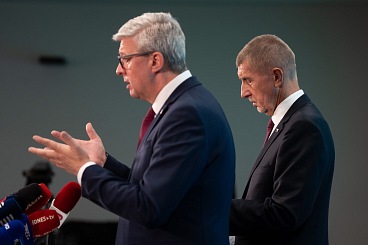
The central bank keeps the basic interest rate at 3.5%. According to experts, it will not change until the end of the year.

The Governing Board of the Czech National Bank left the key interest rate unchanged at 3.5 percent at Thursday's meeting, a level it has maintained since the end of May. The primary reason is the persistent inflationary pressures. Experts expect rate stability at least until the end of this year.
Economic analysts largely agreed even before the November meeting that interest rates would not change this time either. There are several reasons: the economy is growing at a brisk pace, pro-inflationary factors predominate in terms of risk of achieving inflation targets, and the crown is not increasing its gains further.
Inflation remains the biggest scare. Economists warn especially about higher prices in the service sector, most visibly perhaps in hospitality and accommodation services. Real wages and property prices are also growing quite quickly, including higher rents.
The Bank Board voted unanimously
Vice-Governor of the Czech National Bank, Eva Zamrazilová, also indicated a stabilization of rates at 3.5 percent in advance, according to whom they should remain at the current level at least until the end of the year. Her colleague from the Bank Board, Jakub Seidler confirmed the fear of further price increases when stating that persistent increased inflation in services requires the maintenance of mildly restrictive monetary conditions. All seven board members finally voted to maintain the interest rates without change.

"Continuing inflationary pressures do not allow for rate cuts. Our goal is to prevent the growth in the amount of money in the economy from increasing,"
said Governor Aleš Michl at a press conference after the November meeting, adding that the main driver of the domestic economy remains household consumption.
During the wave of inflation, the central bank kept the main interest rate at seven percent, and began to lower it in December 2023. So far, the banking board last relaxed monetary policy in May, when it cut the base interest rate by a quarter of a percentage point to its current level.
Analysts do not expect a change in rates in the next period either
And what will the next development be? More will be suggested by the end of November, when details about the growth of gross domestic product and wages, along with clearer contours of new government policy, should be published. These could lead the central bank to possible communication adjustments. Possible increases or decreases could depend on inflation development and the global economy.
However, economists are generally skeptical about possible rate adjustments. According to Martin Krones from Raiffeisenbank, "with a high probability approaching certainty, it will not change even at the last this year's meeting in December".
"Most likely, the Czech National Bank will not reduce its rates even in the pre-Christmas period,"
added Petr Dufek, an analyst at Creditas Bank.
According to Radomir Jace, an economist at Generali Investments, the lingering price pressures in services and in the real estate sector, a relatively robust growth of the gross domestic product reported for the third quarter, and a strong increase in wages reported in the second quarter may lead the central bank to act cautiously.
"The Czech National Bank may keep its interest rates unchanged for several quarters,"
said an expert for LP-Life.
"The rhetoric of the central bank regarding persisting pro-inflation risks confirms our belief that rates can remain at the current level of 3.50 percent for at least a year. However, the Czech National Bank continues to communicate that it can appropriately increase or decrease rates if necessary, in relation to the evaluation of new macroeconomic data,"
The economist J&T Adam Ruschka then wrote to the editorial office.

The central bank will also take into account external risks in its next decision. According to Michl, these are, for example, geopolitical events, including a possible increase in oil prices, and the behavior of other central banks. The purpose of the current policy of the Czech National Bank is to keep the growth of prices around two percent. The next meeting of the bank board will take place on December 18th.
Interest rates on bank deposits and loans depend on the central bank's rates. Higher interest rates bring businesses more expensive investment and operational loans, and households more expensive housing loans. However, at higher interest rates, the valuation of deposits in accounts is increasing.

The crown rate is stable
The decision of the Czech National Bank to maintain the rate was also expected by the market. Therefore, the Crown did not react to it. It had already strengthened slightly to the border of 24.33 crowns per euro before the meeting.
"Markets widely expected a decision on rate stability. Thus, the reaction of the crown rate is very limited,"
added for ČTK the chief economist of XTB, Pavel Peterka.
Sources: author's article, own questioning, CTK