To be fair: The rise of AfD is not such a big concern for the world, but rather for Czechia


Those who persevere, win. This is how the greatest success so far of the German extremists from AfD could be briefly described. They decisively won the elections in Saxony-Anhalt, the smallest and poorest federal state in Germany. If we look at the language of macroeconomic indicators, Saxony-Anhalt is somewhat of a mirror of Czechia.
"It's not widely known here, but the first state of the Weimar Republic where the NSDAP won elections was....yes, Anhalt. In the state elections in April 1932, the NSDAP received 40.9 percent of the vote there. Thanks to this electoral success, the very first Nazi state premier in German history, Alfred Freyberg, was elected," commentator Petr Honzejk noted on the social network X. Since we cannot see into the future, we have no choice but to draw on experiences from the past. While history does not repeat itself, this comparison seems to be suspiciously accurate.
It is particularly evident in the connections between parts of the AfD party members and German neo-Nazi circles. In its simplest form, this is illustrated by the popularity of the Nazi salute among AfD youth.
AfD and the Return to GDR Times
However, a more interesting comparison from a domestic perspective presents itself through the lens of our shared history with Saxony-Anhalt in the second half of the 20th century, and not only because it is a period substantially closer to the present. The state naturally belonged to the GDR, which was, together with Czechoslovakia, a vassal satellite of the Soviet Union through the Warsaw Pact until 1989.
During that time, quite a lot changed on both sides of the Iron Curtain. For example, in 1948, when Czechoslovakia took the communist path unlike West Germany, both countries had comparable GDP per capita. Czechoslovakia was even about 10% better off, but the values are somewhat relative from today's perspective. However, by 1989, it no longer reached even half of its neighbor's performance. Today, according to IMF estimates, Germany has $65,303 in GDP, the Czech Republic $39,795 per capita.
The Velvet Revolution brought about catching up with Western countries, but the domestic economy is not racing at such a pace that we would have German salaries here in a few years, as ex-Prime Minister Petr Fiala predicted from his crystal ball not long ago.
In Saxony-Anhalt, this indicator is much closer to Czechia than to the German average. Last year, the average resident there reached 38,452 euros in GDP.
"Saxony-Anhalt is a struggling region of Germany, that is also a well-known fact. A quarter of the population has emigrated westward (the most of all people from the GDR). Those who left were mainly young people, so as a result S-A has the oldest population of all federal states. The lowest GDP per capita in Germany, and only about 10% higher than in the Czech Republic. In terms of poverty or social exclusion, the state is also above the German average, but not significantly; it is stated that despite high unemployment (8%), there are many unfilled job positions in the state. There is a lack of qualified people because they left for the West. No new companies are being established here. Statistics claim that in the first half of 2026, over 3,000 new companies (startups) were established in Germany, but in Saxony-Anhalt only 5,"
calculates on FB well-known blogger and member of the Pirate Party Jiří Hlavenka additional data about Saxony-Anhalt, where a party historically linked to Russian influence and money is now celebrating electoral success.
Are we counting money in our wallet with an emotion calculator?
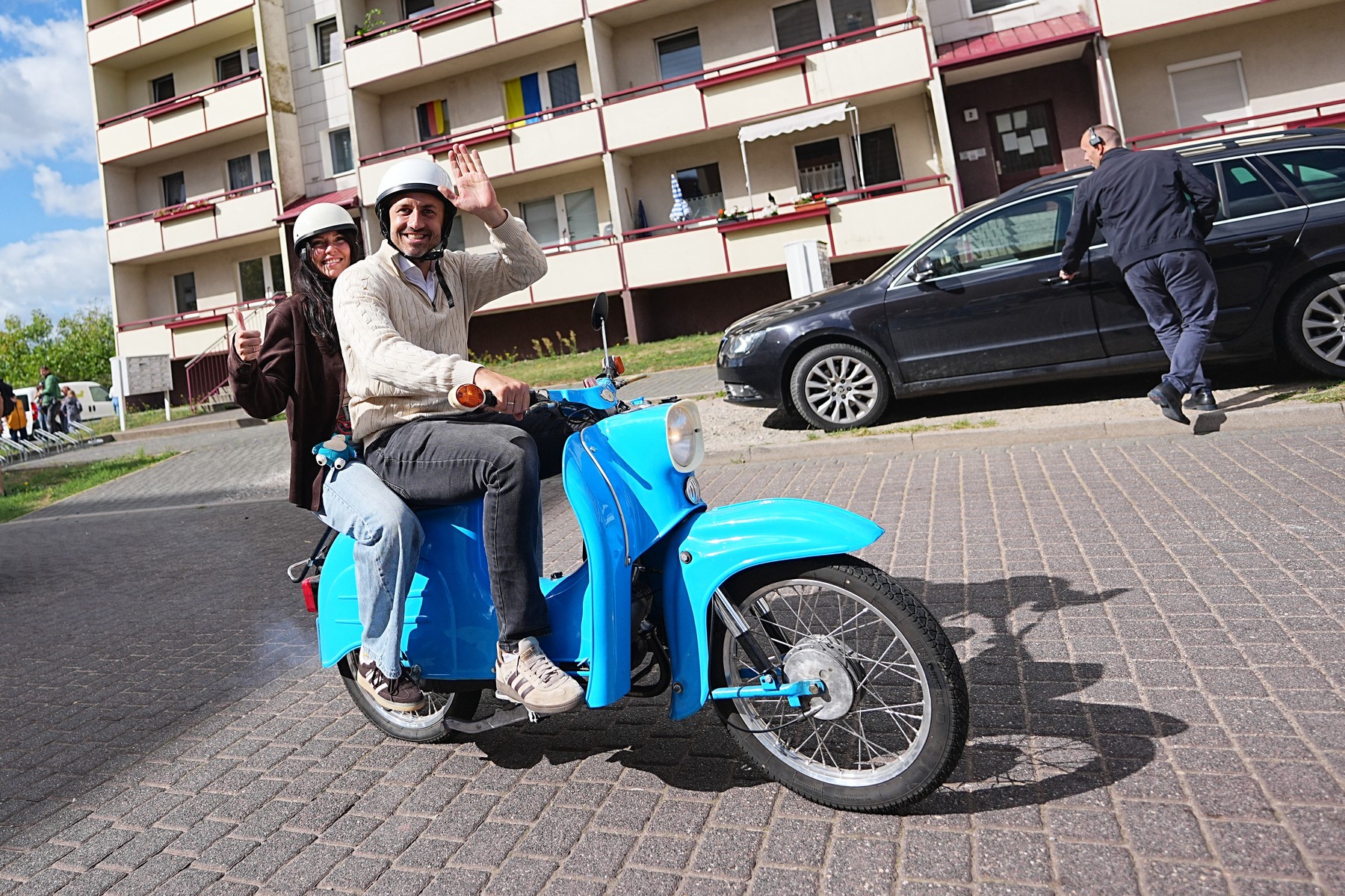
One of the driving forces behind the party's electoral success was Ostalgie for the times of the former GDR, most often documented by wild rides on Simson motorcycles. Due to the exodus of young people, the breeze of the good old days took hold. From an economic perspective, however, it only has the potential to further deepen the region's economic decline.
However, another card was played in the elections, and that is the problem of migration. Into the GDR, just as into Czechoslovakia, enclosed by barbed wire, migrants of any origin could not flow, but the mentioned wires are not semipermeable, and so compared to today it was not possible to go out either.
Free movement also means economic prosperity, which was brought to former West Germany by, among others, guest workers from Turkey. Among voters, xenophobia can be a stronger emotion than the desire for mammon. When someone claims that elections are always decided by the wallet, perhaps it's the kind where money is not counted with a calculator, but through an emotional game. This applies not only in a federal state where not even 3% of the German population lives, but also in the Czech Republic.
Sources: author's text, commentary, IMF, ceicdata.com, X, Facebook, plus.rozhlas.cz