Great success for the Czech medical team: passed at WHO, will be able to participate in foreign missions

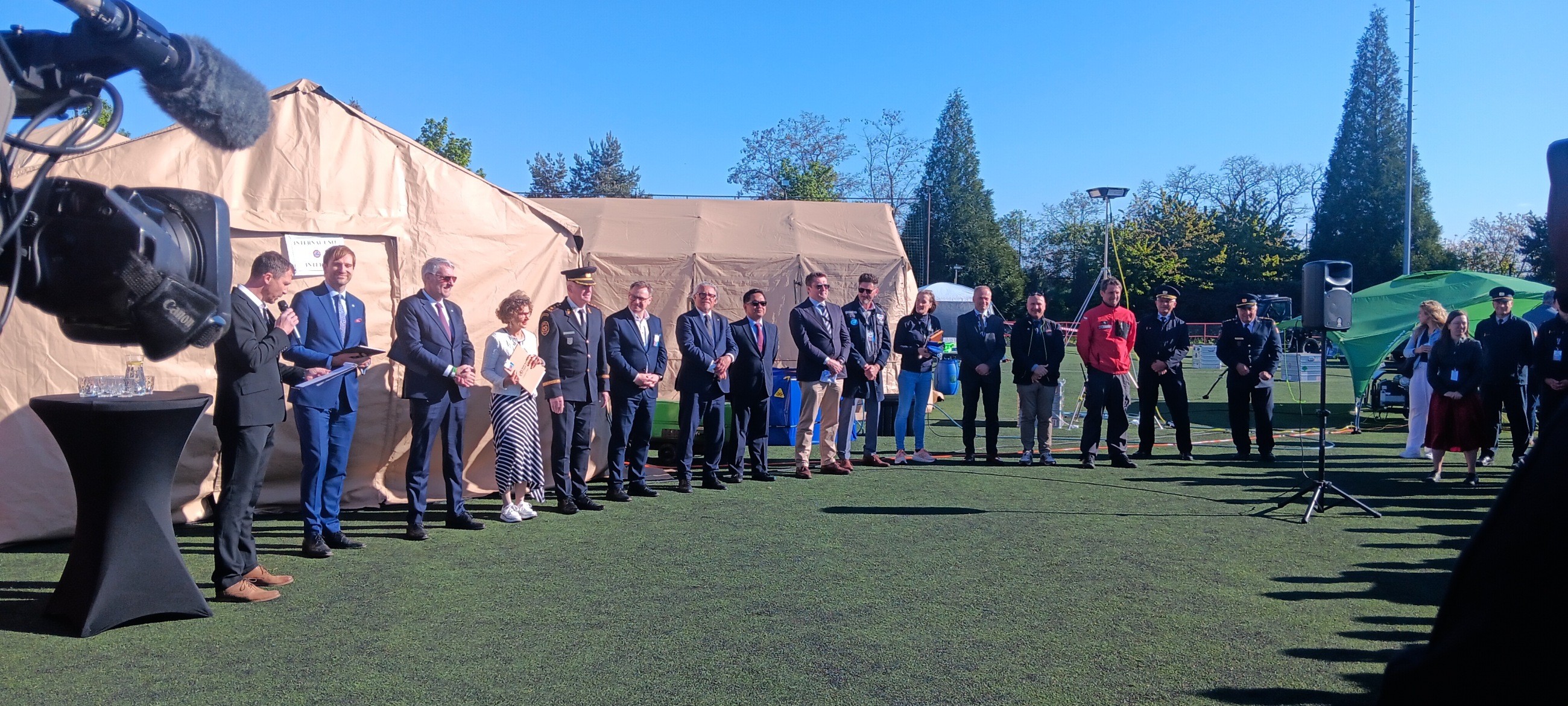
Yesterday, an extraordinary visit arrived in Prague's Strašnice. The training ground at the FK Union football stadium was visited by a delegation from the World Health Organization. The purpose of their visit was to decide on granting certification, which would authorize the CZERT EMT1 team of healthcare professionals to participate in international missions and provide care to people affected by extraordinary events, such as epidemics or natural disasters. This was ultimately achieved. The Minister of Health Adam Vojtěch, the Minister of the Interior Lubomír Metnar, and other notable figures came to congratulate them.
The team consists of a total of 38 members. It is made up of 26 healthcare workers, while the rest of the members are responsible for logistics. It is an experienced team that has previously operated in events like the earthquake in Nepal. Thanks to its own logistical and technical facilities, it can start providing medical care at the site within 24 hours. The first part of the verification visit was held the day before.
Childbirth is not a problem
On Wednesday, Major General Petr Ošlejšek, Deputy Director General of the Fire Rescue Service of the Czech Republic for IZS and operational management, was also present at the site, along with Vlastimil Vajdák, Director of the University Hospital in Brno. Naturally, the commander of the certified medical team, Milan Krtička, was also present. Zsófia Pusztai, Head of the World Health Organization (WHO) Office in the Czech Republic, was observing the event nearby.
Lubomír Metnar arrived on site in great spirits, enthusiastically shaking hands with all the medical staff. His ministerial colleague Adam Vojtěch arrived with a slight delay, which he immediately apologized for, citing parliamentary duties.
A guided tour followed, attended by journalists. During it, various crisis scenarios were simulated, illustrating to the ministers and representatives of the World Health Organization the readiness of the training facility and the medical personnel themselves. Both ministers participated in the guided tour with their questions.
The training ground covers a relatively large area and consists of a series of larger tents. Each tent has its clear role and specializes in a different field. We pass through, for example, a tent with the sign "surgery," which has a complete surgical room. Then we enter the gynecology room, where it is also possible to perform a cesarean section, among other treatments. Medical personnel can provide acute medical care directly at the site of intervention in four other areas: internal medicine, intensive care medicine, infectious diseases, and pediatrics. An anesthesiologist is also a member of the team.
Great Prestige, We Have Almost the Highest Care Standards
According to Lubomír Metnar, the governments of the affected countries can even choose from the certified teams which one they specifically invite. He says it's currently impossible to determine where exactly the team will operate, as it depends on demand.
"For me, it is really, let's say, a great prestige and a reputational matter for the Czech Republic. I wish them much success and good fortune,"
he stated.
He also commented on the currently discussed topic at the venue, which is the Czech Republic's failure to fulfill its commitments to the NATO military alliance, criticized by the head of state, Petr Pavel.
“We are discussing this commitment. It is not a chase for the number, but for the state of the army,”
he explains.
The medical part of the guided tour is led by the head of the medical team, Milan Krtička, who explains everything in detail. The commander of the Prague firefighters Jiří Pokorný then takes the floor, presenting the logistical part to journalists and the delegation.
According to the Minister of Health, Adam Vojtěch, the Czech team will be part of a broader international structure consisting of a total of 65 teams from various countries, 35 of which are in Europe, and will be deployed with the financial participation of the Czech Republic. If approved by the government, a total of 10 million crowns would be allocated for these purposes from the state budget. Other costs will be covered by the budget of the World Health Organization or the affected country itself. The team's training is funded by the budget of the Ministry of Health and the respective university hospitals.
"This is almost the highest standard of these humanitarian foreign units. Some of these teams really only have the basics, let's say, at the level of a military field hospital. Here, there is truly a relatively broad spectrum of care that colleagues are able to offer. That is the added value,"
said Adam Vojtěch.

According to him, the team will be ready within 72 hours if needed. The exact departure time is determined by specific logistics - as he says, trips within Europe are easier because they don't necessarily require a flight. However, the transport of the team to countries outside of Europe is ensured, according to the Minister of Health.
After the tour, the official part follows, accompanied by speeches from the present officials. The delegation will officially award the Czech team a certification and ceremoniously present them with a printed certificate. The success is then celebrated by everyone with a toast, after which both ministers enter the crowd of present doctors to personally congratulate them.
Source: original text