On the Level: Czechia Looks for Its Peter Magyar: A Revolution That Shook Budapest Isn't Planned Here Yet


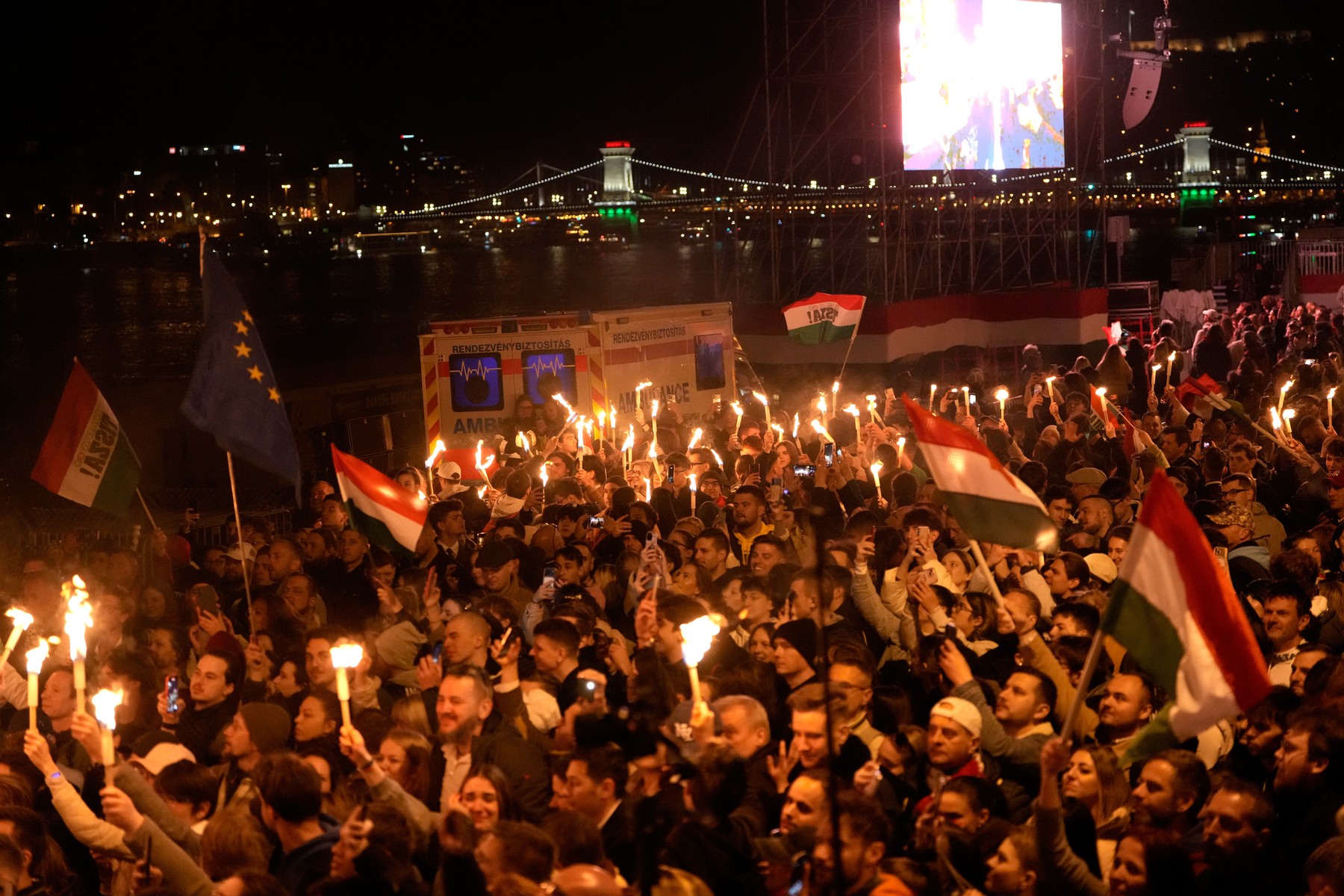
Footage from Sunday night in Budapest went around the world. At first glance, it differed from the stereotypical speeches of political leaders after winning elections in the celebratory headquarters of political parties, as we know them not only here but across Europe. The Czech Republic is also ripe for a fresh wind like the one blowing in Hungary, though a revolutionary nature of events is hopefully not on the table for us.
Crowds of tens of thousands of people stood illuminated by burning torches on Batthyány tér, or Batthyány Square, named after the first Prime Minister of the Kingdom of Hungary, whose legacy from the mid-19th century was claimed by the man for whom the gathering took place.
Behind Péter Magyar, the monumental Hungarian Parliament shone, and in front of him stood the towers of St. Anne's Church.
"Yesterday's victory of the opposition in Hungary is, like the Polish elections in 2023, a victory for democracy, not only in Europe but around the world. Above all, it is proof of the resilience and determination of the Hungarian people—and a reminder for all of us to continue advocating for justice, equality, and the rule of law,"
Commented on the event by Barack Obama on the network X.
The former US president does not express himself with the same enthusiasm about elections in every country with 9.5 million inhabitants. Hungary was brought into American politics by Donald Trump, who often spoke about Viktor Orbán as his role model in his last campaign. However, after sixteen years, Orbán has found himself on the bench of the defeated.
The events resembled a revolution much more, although in the familiar velvet coat, and not just because of Obama's commentary or the unusual visuals within the genre of celebrations after winning elections.
Magyar called on the president to appoint him as prime minister and then resign. Other key institution leaders should also resign; otherwise, he'll deal with them. And he can spin the wheels quite quickly now. He holds a constitutional majority and a firm-handed government system inherited from Viktor Orbán. The former hegemon of Hungarian politics built his "illiberal democracy," also referred to by some as fascism, obviously for his own needs. Now the revolution is devouring its children, and Fidesz representatives sitting on thousands of state apparatus seats are at Magyar's mercy.
Although the star of this year's electoral battle spoke in front of blazing torches about building a system of "checks and balances," this may well remain purely rhetorical. Magyar's voters are not particularly interested in this. However, there will certainly be no hindrance towards the representatives of Fidesz.
For comparison. Recently, we witnessed a prolonged dispute over the president's right to appoint a minister. As it turned out, the government has no leverage over the president. However, if it had a constitutional majority, it could quickly amend the Constitution with a single word to "must," and that would settle it. The Constitutional Court would then not be able to intervene, and this principle could be continued in everything.
In Hungary, the situation is even more comfortable not only because it lacks a Senate. The revolutionary atmosphere was then recounted by the Hungarians themselves. They participated in the elections in record numbers, but did not disclose their voting preferences to the media, as confirmed by the Czech reporters on the ground. They supported change but were afraid of how the revolution would turn out.
Such revolutionary conditions definitely do not exist in the Czech Republic, but the search for a soft version of Peter Magyar is suggested. The Czech Republic also has its political veteran. The ANO movement and its leader have been in politics for 4 electoral terms and have been in government three times. A change of course was brought by the government under the leadership of the ODS, the only party alongside ANO that had one person in the prime minister's chair for two terms (that was Václav Klaus).
It may seem that the political pond in the Czech Republic is enjoying quite stagnant waters. A gust in the spirit of Peter Magyar could stir the surface a bit towards reforms that have been discussed domestically for those 16 years. Whether it's unsustainable pensions, demographic issues, housing, higher and regional education, an exhausting economic model, or perhaps the crisis in Czech football.
However, Peter Magyar is neither a random passerby nor a dissident in the spirit of Václav Havel, even though on Sunday night he talked about the victory of truth and love following his example. For many years, he lived within a nepotistic system of his wife's patronage, who was considered Orbán's successor until the crucial scandal with the issuance of pardons.
As long as Magyar was taking care of his children in the role of a caring father, it probably suited him, but then he turned and left the side to dismantle it. Is there anyone in the ANO movement today, or in another party, hiding an extraordinary political talent, ready to set sail with a fresh political wind?
However, it lies in something other than occupying positions. Peter Magyar visited 6 district towns and small towns daily and mobilized 50,000 volunteers, whom he thanked for their devoted campaigning in front of the illuminated parliament. He also gained the support of local zoo directors, symbolizing representatives of local elites who ran for Tisza.
Whoever can achieve something like this can start a small revolution in any European country, and here, apart from the demonstration at Letná, nothing indicates such a development.