It is not our place to intervene in the internal political life of other states, unlike the Austrian who participated in the protest in Bratislava, claim Slovak politicians.

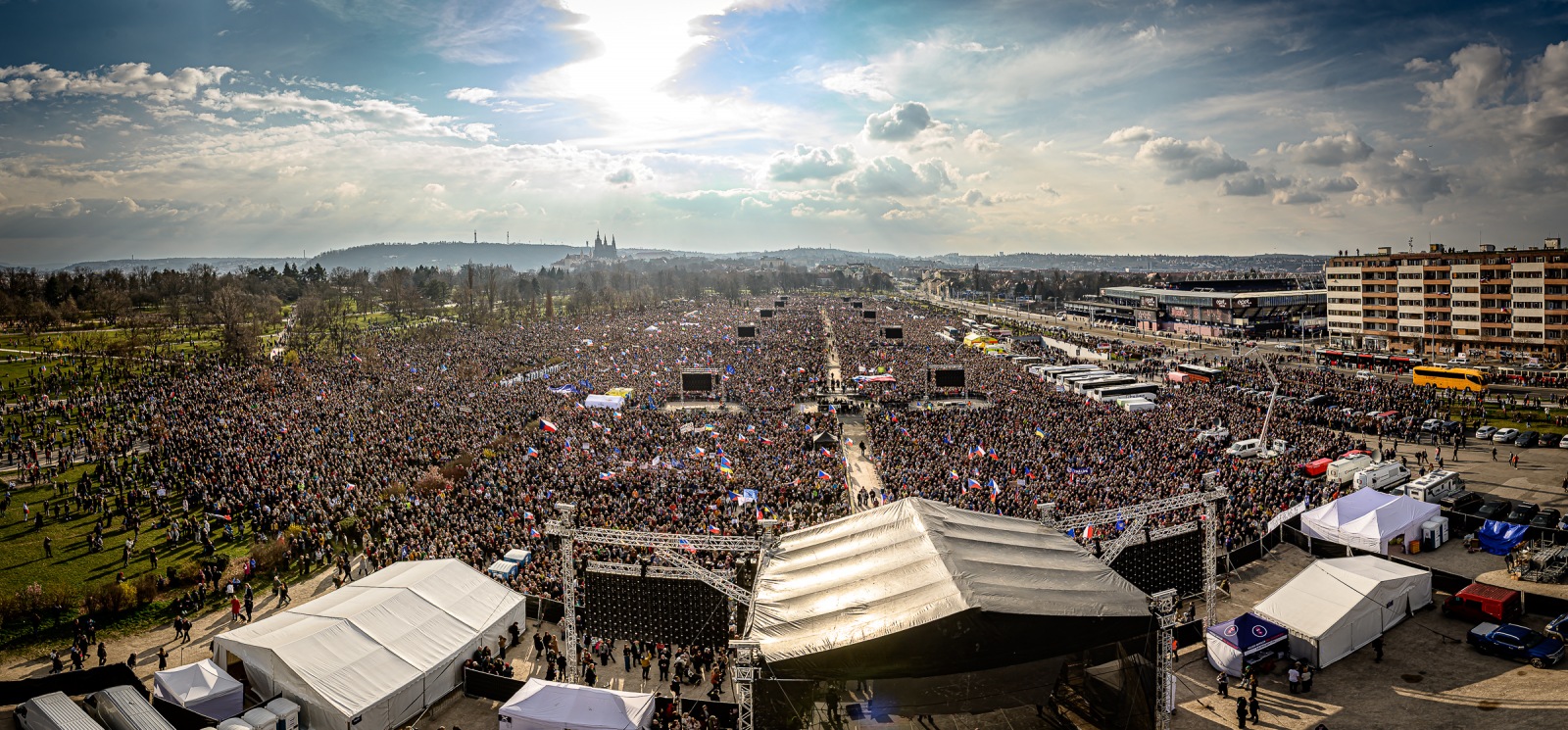
Tens to hundreds of thousands of people came to express their disagreement with the policies of Prime Minister Andrej Babiš's government, and the protest quickly made headlines in international news agencies. Reports repeatedly included comparisons with Slovakia, where regular anti-government demonstrations have recently been taking place.
Czech Republic Experiences Protest Similar to Slovak Ones
Slovak news portals primarily highlighted the parallel between the situation in Prague and the political atmosphere in Slovakia. In comments and analyses, they pointed out that protests have become a significant political tool in the entire region in recent months. According to Slovak media, Letná resembled large civic gatherings that have taken place recently in Bratislava and other cities, writes the portal protesty.info.
In Slovakia, protests appear relatively regularly and often respond to political decisions of the government or the direction of foreign policy. Slovak media also point out that the Slovak example became one of the arguments for the Czech organizers of the protest. Some of them openly spoke about not wanting the Czech Republic to follow the same political path as some countries in the region.
Return of Mass Protests
Czech media described the weekend gathering as one of the largest anti-government events in recent years, writes Reuters.com.
A breathtaking crowd of one hundred thousand gathered at Letná. The chairman of the association, Mikuláš Minář, responded directly from the stage to the sight of the crowded plain and declared:
“There are at least 200,000 to 250,000 of us here,”
He announced to the crowd after viewing the current footage from above through drone imaging, as reported by the portal Novinky.cz.
Foreign agencies also pointed out that people from practically all regions of the country attended the protest. The demonstration proceeded peacefully, and participants saw it as a way to publicly express disagreement with the new government's policy.
Criticism of the Government
The demonstrators primarily criticized several steps taken by the government, which they believe could weaken the democratic environment in the country. The planned changes in the operation of public media, which according to protest participants raise concerns about political influence on their functioning, were at the center of the criticism. Another discussed topic was the reduction in defense spending at a time of increasing security tensions in Europe. Another point of criticism was the prepared legislative amendments regarding non-profit organizations. According to the protest organizers, these changes could restrict the functioning of civil society and independent initiatives. Activists also pointed out that they believe there is a gradual weakening of democratic institutions and a concentration of political and economic power in the hands of a narrow group of people.
These very concerns were also behind the convening of the assembly. Organizers claim that the protest is a response to growing tension in society and to government actions which they believe may lead to a gradual "erosion of democracy" and weakening of civil society.
Warning against the "path of Slovakia and Hungary"
One of the moments that elicited a strong response in the media was the statement by the organizers about the country's direction in the Central European context. A call was made on stage:
"We are here to clearly stand against dragging our country onto the path of Slovakia and Hungary."
This statement sparked a discussion not only among protest participants but also in the media and among political commentators. The organizers were alluding to concerns from part of the society that the Czech Republic could gradually approach a governance model that critics attribute to some countries in the region.
In the case of Hungary, this particularly refers to the long-standing disputes of Viktor Orbán's government with the European Union on issues of the rule of law, media independence, and the functioning of non-profit organizations. Critics argue that there is a centralization of power and a weakening of independent institutions. When mentioning Slovakia, protesters referred to the political tensions of recent years, which resulted in regular demonstrations in the streets of Bratislava and other cities. According to the protest organizers, it is an example of a country where society is significantly polarized and political conflicts often spill into the streets.
Some participants of the gathering emphasized that civic activity can be a tool to prevent such developments. According to them, the protest at Letná was meant to send a signal that part of the Czech public wants to defend democratic rules before they are weakened.
Slovak Politicians Respond to Mention of Slovakia
The organizers' statement that the Czech Republic should not follow "the path of Slovakia and Hungary" also sparked reactions among Slovak politicians. The editorial team of LP-Life.cz therefore approached representatives of several political parties with a question on how they perceive the protest at Letná and the mention of Slovakia in the organizers' speech.
The Slovak ruling party SMER - SSD emphasized that it respects the right of citizens to peaceful assembly and expression of opinion, but at the same time does not consider it appropriate to interfere in the internal political issues of other countries.
"Unlike previous governments, SMER - SSD never shot at protesters with rubber bullets or used water cannons. We respect the right to peaceful assembly and expression of opinion. It is not for us to interfere in the internal political life of other states, unlike the former Czech Minister of the Interior, Mr. Rakušan, who personally participated in an anti-government protest in Bratislava, which is absolutely unacceptable,"
stated the party in its stance for LP-Life.cz.
It also reminded that Slovakia is, in its view, a solid part of the European integration structures and rejected comparisons of the country to authoritarian regimes.
"What path of Slovakia and Hungary is the organizer talking about? In terms of integration, the Slovak Republic is the furthest ahead among the V4 countries, for instance, we are the only ones to have adopted the euro currency. We are certainly not on the trajectory of the Russian Federation. We respect the results of the parliamentary elections and nobody questions them,”
stated SMER – SSD.
Political Background of the Protest
According to foreign media, the protest took place just a few months after Andrej Babiš returned to power. His ANO movement won the parliamentary elections and subsequently formed a coalition government with smaller political parties.
However, the new government has sparked controversy due to the composition of the coalition. It includes political entities that critics label as more radical or populist. Therefore, some commentators argue that the political scene in the Czech Republic is undergoing a significant change.
Foreign Policy and the Dispute over Ukraine
A significant topic of the protest was also the government's foreign policy. Critics point out that Andrej Babiš's cabinet has changed some of the country's previous stances towards the European Union or the war in Ukraine.
According to commentators, the government refused to support certain financial mechanisms of the European Union intended to aid Ukraine and also criticized some of the EU's environmental or migration policies. According to critics, this has brought the government closer to the stances advocated by the governments in Hungary or Slovakia.
Controversial Laws and Investigations
The discussion has also been stirred by some proposed legislative drafts. Critics point out in particular a law that would introduce the registration of non-profit organizations funded from abroad. Opponents argue that such a regulation could resemble the legislation used in Russia and could be abused to limit civil society.
Tensions were also heightened by the parliament's decisions regarding the criminal cases of some politicians. Recently, MPs refused to allow the continuation of criminal prosecution of the prime minister in a case of suspected fraud involving European funds. Protest organizers claim that such decisions can create the impression that there are two groups of people - ordinary citizens and those who are untouchable by the law.
Strong Words from Entrepreneurs and Scientists
Minář sharply criticized the prime minister's advisor Natálie Vachatová on stage.
“It’s hard to imagine anyone more pro-Russian,” stated Minář, mentioning, for example, the business activities of her brother with the Russian Sberbank and her public statements supporting Russia. He described Vachatová as an “unbelievable security risk.”
Zdeněk Svěrák called the plan to nationalize radio and television an audacity, not a joke. According to him, it represents a serious intervention in independent media. The audience at Letná then sang a song for him on the occasion of his upcoming 90th birthday.
The performances of personalities from the academic and business environments also drew great attention from the audience.
Minář stated that the Czech Republic faces years that will require personal sacrifices. According to him, it is no longer just about Babiš or Okamura. The question is not whether democracy will be threatened because that is clear. The essential thing is the role of each of us and what each person will do.
"It's no longer about Babiš or Okamura. The question isn't whether they will destroy democracy. They will, we all know that. The only question that should concern us is: What will we do? Don't wait for Havel, or Pavel, or Minář. We face a fight, civil resistance, months of nonviolent resistance. Our motto won't be to fight, but not to be afraid,”
mentioned.
Minář called for greater engagement from people, both in organizing protests and joining political parties. Every participant of Letná should ask themselves how they can contribute. "Don't wait for Havel, nor for Pavel, nor for Minář," he said. He emphasized that we face a fight of civic resistance and months of non-violent resistance. His motto for this time is: do not fear, no fight.
Entrepreneur and philanthropist Dalibor Dědek, known for his support of Ukraine and defense projects, reminded of the historical experiences of the Czech Republic with the occupation by Soviet troops.
"When I was 11 years old, I saw Russian tanks in the streets. I don't want to experience that again," said Dědek, adding that protecting democracy at home is just as important as helping countries facing aggression.
Similarly critical was the renowned biochemist Václav Pačes, who pointed out parallels with the period of normalization. According to him, there is a risk that formally democratic rules will remain in place, but the reality may gradually be different.
Pačes also commented on the proposed law on the registration of non-profit organizations and critically remarked on some political parties:
"Now it seems to me that the things we have fought for, like democracy and freedom, are slowly being eroded,"
added Pačes.
Ordinary participants also spoke at the protest, explaining why they came to Letná. A young student Michael Černohlávek told the media that he came to support the values he considers essential.
According to him, society does not always realize that democracy and personal freedom are not a given and that it is necessary to protect them.
Singer Helena Vondráčková commented on the video from Letná and strongly distanced herself from its content. According to her agency MM Praha, s.r.o., which represents her, the song "Přejdi Jordán" was used without her knowledge and consent in a reels video published by former minister Marian Jurečka. The agency stated that Vondráčková does not wish for her artistic performance to be associated in any way with the political opinions or statements of third parties. The artist clearly distances herself from the use of her singing in connection with the demonstration and refuses to have any political stance interpreted on her behalf.
Opposition Politicians Among Demonstrators
Some representatives of the opposition also appeared at the protest, although the gathering aimed to emphasize a mainly civic character. Among the participants were politicians from the ODS and Pirate Party, who came to support the protesters.
Organizers also pointed out that the aim of the gathering is not to support a specific political party, but to pressure the government and defend democratic rules.
Foreign Media: Concerns About Developments in the Region
Reports about Letná were quickly picked up by major world agencies and media. Reuters, AP and British newspapers mainly emphasized the concerns of part of the society about the possible weakening of democratic rules in the country.
Foreign journalists noted that Letná Plain has strong symbolism in Czech history. It was here in 1989 that massive gatherings took place during the Velvet Revolution, which helped end the communist regime. This is why every large gathering at this place has a significant political and historical dimension.
Other Slovak political parties also reacted to the protest and its political context. Member of the Hlas - Social Democracy party Róbert Puci stated that peaceful protests are a natural part of a democratic society if they respect the election results and the political will of the voters.
According to him, it is important for different groups in society to respect each other, even if they have different political opinions.
"It is good that people were able to gather and peacefully express their opinion, even in the form of a protest. This is something they couldn't do in an authoritarian country - and this is something the speakers should realize. Democracy is also about respecting the election results. Every person's voice carries the same weight, and mutual respect is necessary, even if we don't like the opinion of another group of people,”
stated Puci.
An alternative perspective was offered by the opposition party Progressive Slovakia. Member of Parliament Dávid Dej stated that he sees civil protests as a legitimate way for society to highlight concerns about the development of democracy.
According to him, it is natural for a segment of the public to respond to political decisions through public gatherings.
"I am glad that the citizens in the Czech Republic feel the need to fight for the protection of the pillars of democracy, which include independent media and trustworthy public institutions. Organizing a protest is a legitimate way to show one's disagreement,"
Dej stated.
He also pointed out that the mention of Slovakia in the organizers' protest speech, in his view, shows how the political situation in the country is perceived abroad.
"I think such a statement proves the negative perception of the current government's behavior abroad. The use of Slovakia as a deterrent example, even in connection with Hungary, illustrates that the public does not perceive a fundamental difference between Fico's and Orbán's autocratic practices. It is a reflection of the current government's work. Therefore, our role as the opposition remains to protect the rule of law, highlight attempts to weaken the power oversight bodies, and cooperate with European partners,"
he added.
Parallel to the foreign demonstrations, a series of student protests under the name Ring the Alarm! is currently being prepared in Slovakia. The initiatives Student Protest, Student Movement for Open Culture, and Student Clubhouse in Žilina are calling on students and the public to join the planned gatherings that will take place on March 25th at 6:00 p.m. in several Slovak cities - in Bratislava, Banská Bystrica, Košice, and Žilina. The students aim to draw attention to the current developments in the country, government actions in public media, changes in electoral rights, and concerns about the direction of foreign policy. They also highlight issues that remain on the fringe, such as housing availability, the state of education, and the emigration of young people abroad. According to the organizers, the current social atmosphere is accompanied by chaos, questioning of facts, and seeking out enemies, with the Prime Minister avoiding public discussion, writes Aktuality.sk.
Protests as a New Phenomenon in the Region
Analysts point out that Central Europe has been experiencing a return of mass civil protests in recent years. Thousands of people regularly appear in the streets not only in the Czech Republic but also in Slovakia, Hungary, and Poland.
According to many commentators, the Letná demonstration is not an isolated event but part of a broader trend in which the public tries to influence political events directly on the streets. Organizers have also hinted that similar gatherings may continue in the coming months.
The mass protest at Letná in Prague sparked a number of reactions not only among Slovak politicians but also among the Slovak people themselves
Comments on social media reflect skepticism, sarcasm, and even concerns about the organizers' motivations.
Many Slovaks question the reported numbers of protest participants. According to them, the media often exaggerates figures, stating that hundreds of thousands of people were unrealistic, and the number of police officers supposedly overseeing order was disproportionate. One commentator remarked:
“Hundreds of thousands? You can't even gather that many at a concert. Once again, the media are misleading.”
Another reflected on the motivation:
“Dozens of police officers for 200–250,000 people? They slightly underestimated, didn't they?”
There were also concerns about foreign influences:
“And how many foreign agents?”
Many comments compared the protest to local experiences in Slovakia. It was pointed out that while serious crises are happening in the world - pandemics, wars, geopolitical tensions - some citizens are focusing on demonstrations against their own government.
"Covid came, the war in Ukraine came, another war in the Middle East came, the world is going to hell..., but someone feels the need to protest against domestic politicians. Wake up, people."
Commentators often claimed that the protesters cannot accept the democratic outcome of the elections.
"But they should have gone to vote. And if they voted and lost, why are they protesting against democracy?"
Another pointed out the lack of self-criticism:
“A recurring scenario. Democrats who cannot accept the election result.”
Similar opinions appeared in connection with the political situation in Slovakia, where according to commentators, the opposition also reacts to defeat with streets, not ballots:
“It's the same scenario as here... A Maidan on request.”
Reactions were often tinged with humor. Some commentators compared the demonstration to a concert or celebration:
“Damn, that's some concert.”
Another added:
“They sang and went home. Nonsense. Symbolism is neither strategy nor tactics.”
The comments also featured exaggerated numbers and irony:
“A million moments and you're in ecstasy.”
The Slovaks pointed out that the protest could have been motivated politically or financially:
“Nicely and simultaneously hideously devised. This is a months-planned and professionally organized event with a budget of several million €, which someone paid for and just used people for their needs.”
Some suggested that the participants' money and time could have been used more effectively:
"If everyone present had put 1 Euro into a pot, they would have raised at least 200-250 thousand, and if 10 €, it would have been 2-2.5 million. With that, they could have really helped someone in need... but then probably no one would have come to the demonstration."
The protest was also seen as a symbolic resistance to possible external influences on the country or as a warning about the direction of policy. One comment clearly expressed concerns:
"They are against dragging the Czech Republic down the path of Hungary and Slovakia."
Others reminded that the ordinary citizen gains nothing from such an event:
"It's just a money laundering operation. The average working Czech gains nothing from it."
Slovak reactions to the protest at Letná were predominantly critical. Commentators pointed to unrealistic expectations, doubted the number of participants and the motivations of the organizers, reminded of parallels with Slovak political events, and humorously commented on the absurdities of the demonstration. Overall, these opinions show that the public perceives mass protests not only as civic participation but also as a potential misuse of political and financial resources.
Source: author text, Reuters, AP, The Times, Novinky.cz, Plénum.cz, reports of Czech media about the protest at Letná, information from the organizers of Million Moments for Democracy