I'm Taking a Cambodian: Women Attack Mistresses with Acid, This is How Polygamous Society can Look Like


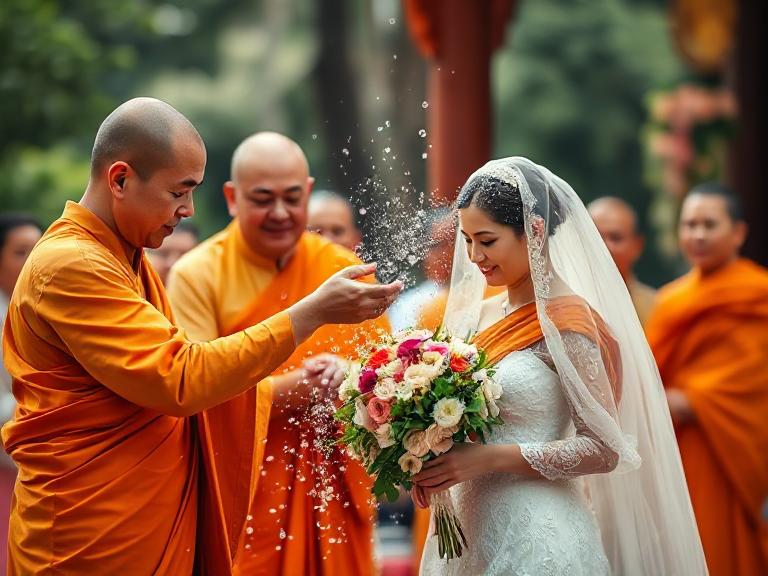
In Cambodia, where the majority of the population practices Buddhism, the wedding is considered a religiously significant ceremony. It traditionally lasts up to three days, but nowadays many couples shorten it to one or two days.
Arranged marriages have a long tradition in Cambodia. Parents often choose the partners, who mutually agree and also set the wedding date. During the engagement, the groom sometimes performs a "service to the bride", i.e. helps the family of his fiancée. Although today young people have more freedom in choosing a partner, parental consent remains an important sign of respect. Men usually marry at the age of 20 to 25, women at the age of 16 to 22. Marrying into a good family is still considered a way to show gratitude and respect to parents.

Dowry
In Cambodia, it is customary for the groom to pay the bride's parents a dowry and cover all costs of the wedding. The amount of the dowry is intended to symbolize his ability to take care of his wife and respect for the family. If the girl were to get married without a dowry, it would be considered a disgrace.
Legend and wedding ceremony
A traditional Cambodian wedding lasts three days and three nights. The number three is particularly lucky for Cambodians because it is associated with the three jewels of Buddhism - Buddha, the monastic community Sangha, and Buddha's teachings Dhamma. The Khmer wedding ceremony is inspired by the beautiful legend of the marriage of the first Khmer prince Preah Thong and the princess of the seaside Neang Neak.
The legend of Preah Thong and Neang Neak (Prince Thong and Princess Naga) forms the basis of many Cambodian traditions and wedding customs. In Cambodian culture, the figures of Nagas - divine snakes - appear almost everywhere. Prince Preah Thong was an Indian prince who was advised by a hermit in a dream to head east and find a land that he could call his own and from which a great and prosperous kingdom would emerge. He prepared a ship, supplies and companions and set sail according to the instructions in the dream. After several days, he arrived on an island rich in animals and plants, but without human inhabitants. He decided to claim the island and start settling it. One evening, during a full moon, Preah Thong was resting under a Thlork tree when suddenly the water at the shore shook and a group of people emerged from the sea.
A traditional Cambodian wedding has several traditional steps
Hai Goan Gomlom
The Cambodian wedding begins with the groom's journey and his family to the bride's family, bringing gifts such as meat, fruit, pastries, drinks, and desserts. Upon arrival, guests receive gold trays with fruit and gifts to join the procession, symbolizing his journey to the bride's home. The trays are arranged on the table. Family members and friends are introduced and engagement rings are exchanged.
Sien Doan Taa
Tea ceremony. A couple offers tea to the spirits of their ancestors. Ancestor worship is a common practice in Cambodia, so young couples on their way to marriage also participate. The ceremony takes place by offering tea to the spirits of their ancestors to invite them to the celebration and honor them. This is part of pre-wedding traditions.
Gaat Sah
The literal translation is "cutting of hair". During the Gaat Sah ceremony, there is a symbolic haircut of the Cambodian bride and groom. Don't worry. The bride and groom do not leave the ceremony bald, only a few strands of the bride's and groom's hair are cut. This tradition symbolizes the couple's farewell to the past and the beginning of a new life together.
In the past, the groom's hair was indeed cut, today this ritual is performed symbolically. The head of the family is the first person who has the honor to symbolically cut hair for the couple. After this, the performance of this ritual with a blessing and wishing all the good things are alternated by other relatives and close friends.
Soat Mun
Blessing the monks. This custom, also known as "blessing the monks", has a special place in Buddhist culture. During the ceremony, the monks bless the newlyweds by sprinkling them with water and flowers, accompanied by sacred prayers. Guests silently watch the progression of the ceremony and often bow their heads in respect. However, if the monk cannot participate, a priest or one of the grandparents may bestow the blessing.
Sompeas Ptem
The ceremony of tying the marital knot. The ceremony of tying the knot is one of the most important spiritual traditions that the betrothed jointly undergo. During the ceremony, they kneel side by side, join hands, and together hold a golden sword. This sword has its origins in an old legend called "Holding the knife", and symbolizes fidelity and protection, which the betrothed promise each other. As the couple kneels, relatives alternately tie red cords around their wrists. These represent eternal love and the union of two souls into one. By tradition, the betrothed should wear these cords for at least three days or until they untie themselves.
At the end of the ceremony, flowers soaked in holy water are thrown at the betrothed - this act is supposed to bring health, happiness, and abundance into their shared lives. In addition, guests can also throw white palm seeds at the newlyweds, symbolically wishing them prosperity and happiness.
Bongvul Pbopul
The Cambodian Bongvul Pbopul ceremony follows the culture of using the wisdom of the more experienced community members for the newlyweds. Couples sit in a circle around the newlyweds and give them blessings. Symbolically, they pass three burning candles among themselves seven times in the direction of the clock hands - these represent wisdom, experience, and happiness that are to be passed on to the newlyweds.
Traditional Wedding Dress
Cambodian weddings are extravagant and full of colors, with the bride and groom being the center of attention. During the day, they often change their outfits several times - each ceremony requires different clothing. The bride wears the traditional "kompot", a richly adorned skirt with a top, and changes colors and jewelry depending on the part of the ceremony. The groom, on the other hand, wears traditional pants with an elegant shirt or tunic. The outfit is made of silk sewn with golden threads, which symbolize happiness and wealth. The colors of the bride's and groom's clothing are always matched, adding luxury and harmony to the entire ceremony.
Wedding gifts and food
Wedding gifts are never an obligation, but it is definitely polite to bring some. Wedding guests usually bring cash and put it in a beautiful envelope for the newlyweds. The witnesses then write down in a notebook how much each guest donated. If the couple is ever invited to a wedding of a guest who donated money, they will return the same amount to him.
At the feast, traditional Khmer dances are danced and classic wedding music is played, such as "Som Bon" and "Bondait Kantong". Traditional dishes are rich and varied - from Amok curry with chicken, beef or fish to various appetizers, such as Cambodian rolls, sweets, fruits and vegetables. Each table is set up like a rich buffet full of Cambodian delicacies.
Fidelity and Polygamy
Although Cambodian marriages were often arranged by parents in the past, life after the wedding was usually happy and love between spouses gradually grew. Divorces were rare and domestic violence was almost non-existent. Many couples lived with their parents and extended family, which provided them with strong support, as mentioned on ethnomed.org.
However, today the state of marriage in Cambodia, like many other aspects in the country, has significantly worsened. Years of war and extreme violence have affected families and traditional values. This situation has also unexpectedly reflected in fidelity between spouses. It is now more liberal and economic difficulties, which force men to leave their villages and look for work, further complicate the situation. Cambodian society, therefore, often has to deal with frequent extramarital relationships, abandonment of wives and children. This situation is linked to serious social problems in that society.
The modern constitution prohibits polygamy, but some argue that it is still practiced where a family can financially afford it. The impact of war and mass killing of men during the Red Khmers regime caused a population imbalance between men and women. Social, financial and emotional pressure pushes widows, single women and girls to accept partners even though they are already married. Many children are born out of wedlock and jealousy and conflicts often arise among women over one man.
Violence among women is often brutal. There are also cases of "acid attacks", where a jealous wife throws acid on her husband's mistress. The purpose of the attack is not to kill, but to maim the victim. Such incidents occur across all social strata. The most famous case occurred in 1999 when the wife and bodyguards of a high-ranking government official poured 5 litres of acid on the face of his eighteen-year-old mistress, causing her horrific disfigurement and serious damage to her eyesight and hearing.
Infidelity among spouses can have fatal consequences. Men can contract the HIV virus from extramarital relationships and transmit it to their wives when they return home from work. The number of HIV/AIDS cases in Cambodia is rapidly increasing and also affects children who are born with this virus.
However, statistically, the divorce rate remains low. Divorce is considered a disgrace, especially for women. Social traditions and current family laws favor reconciliation over divorce, even in cases of serious physical or psychological endangerment of one of the partners. For Cambodians, marriage can sometimes be more of a ritual than a legal matter. In the USA, for example, many Khmer men ostentatiously marry and get married without legal registration in order to preserve their entitlement to social benefits. In such cases, divorce is not necessary if the couple does not decide to stay together.
Domestic Violence in Cambodia
Another manifestation of the deteriorating quality of marital life in Cambodia is the increasing domestic violence.
Domestic violence in Cambodia often manifests as physical abuse of women and children by the husband or father. Emotional abuse is just as common. The perpetrators are often very aggressive men. Half of the women who reported being abused suffered injuries, with more than half of these injuries being to the head. Women described beatings, whippings, stabbings, and even attacks with an axe. Violence also often occurs in public.
As one Cambodian woman stated according to ethnomed.org:
"If there are thirty days in a month, it seems like my husband beats me sixty times. The neighbors know that he hits me at night. They always think it's a sexual dispute. Neighbors often advise me: 'When your husband wants sex, you have to give it to him. If you don't, he will hit you.'"
Source : author's text, Theknot.com, Khmerstorylovers3.yolasite.com, Cambodiatravel.com, Philarchive.org, Ethnomed.org