Polyandry of Jodidara: A woman can be the wife of multiple brothers at the same time. She decides with whom she will spend the night.


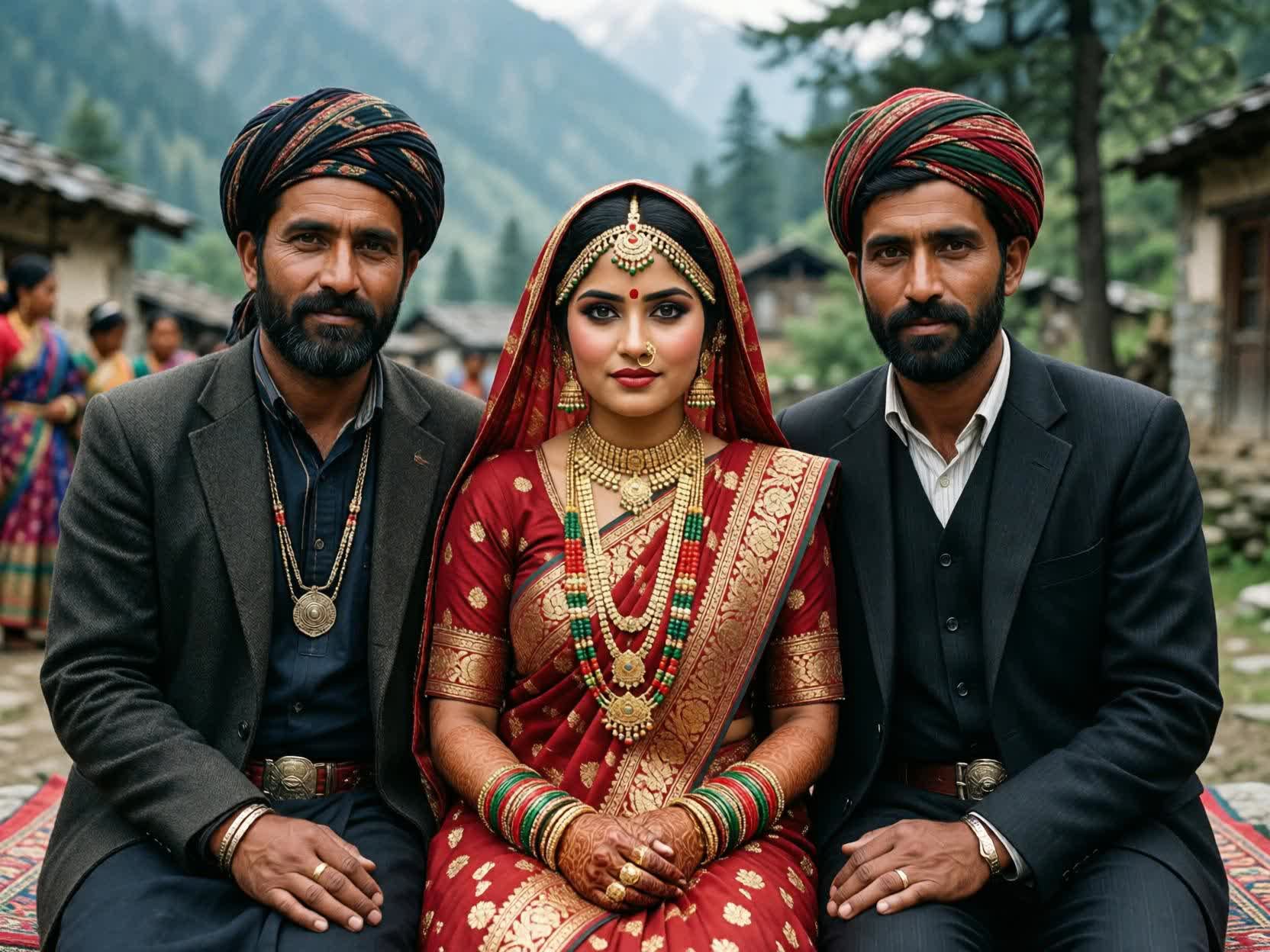
One such example is the tradition of polyandry in Himachal Pradesh, where a woman can be the wife of several brothers simultaneously — a custom that was once common in mountain communities and still persists in some tribal areas. This ritual, known as Jodidara (or Ujala Paksha), is not merely a curiosity. It represents a deeply ingrained social, economic, and cultural system that reflects the living conditions and values of the mountain inhabitants of the Hatti community in northern India.



In the remote mountain villages of Himachal Pradesh, particularly in the Trans-Giri area of Sirmaur district, the landscape consists of slopes, rocky fields, and small, often barren plots. Reports Indiatimes.com. In such conditions, keeping the family heritage and land together was crucial for survival. In a traditional context, dividing land among multiple sons would fragment it into unsustainable parts, threatening the family's economic stability. To prevent this, residents implemented a polyandrous system, where one woman becomes the wife of several brothers from one family.

This type of polyandry is referred to as fraternal polyandry. It means that brothers share one wife. It is the opposite of the more commonly widespread polygyny (which allows a man to have multiple wives). Experts and locals associate this custom with the ancient Indian epic story Mahabharata, in which Draupadi, the queen of Panchala, was the wife of the five Pandava brothers; some believe that mythological and historical references may have influenced the emergence of this custom, providing it with sacred and historical legitimacy for many generations.

What Does a Jodidar Wedding Look Like?
A traditional Jodidar wedding does not follow a strictly defined pattern like a typical marriage. The union can occur between two brothers, but in the past, it could include more men—today, however, the most common number is two.
The rituals begin similarly to a classic wedding: the bride's procession heads to the groom's house, followed by local songs, music, and celebrations that can last several days. Priests (often elder family members familiar with local ceremonies) recite mantras in the local language, sprinkle the couple with holy water, and family and friends bless them with sweets (such as barley or jaggery), symbolizing harmony and prosperity among all parties involved, reports Abplive.com.
The bride then alternates time with each of the brothers according to mutual agreement. In some cases, she decides to spend the night with the older brother and the following weeks with the second one, or according to another agreed schedule. Within the family, the children are considered joint, with the oldest brother often legally recognized as the father, but all the brothers actively share parental responsibility. Writes NDTV.com.
Intimate Life and Internal Rules of Marriage
The question that naturally arouses the most curiosity about polyandry concerns intimate cohabitation. How does a marital life function when a woman has multiple husbands?

According to research by the former Himachal Pradesh Prime Minister and sociologist Y. S. Parmar, who devoted his doctoral work to polyandry, a woman in the Jodidara system surprisingly holds a strong degree of autonomy. It is she who decides how to allocate her time among the individual brother-husbands, with the basic rule being an effort towards balance and fairness to prevent jealousy and tension in the household.
In traditional households, a simple visual signal was sometimes used, such as a hat or shoe placed in front of a room, indicating which man the woman was spending the night with. However, this system assumed that the family had more than one room, which was not always possible in poorer mountainous areas. In many cases, therefore, all the husbands slept in one room, and the woman herself decided whom to join for the night.
Parmar states in his work that a woman has the duty to divide her attention evenly among all brothers. According to his research, complaints or conflicts are rare because the system operates based on clear rules that the community has respected for generations. In addition to partnership life, the woman is also responsible for running the household — cooking, taking care of livestock, and working in the fields. However, if the burden becomes too much, tradition allows for another woman to enter the household, who will become the wife of all the brothers equally.
Voices of the Tradition's Participants
A wedding that took place in the village of Shillai in the Sirmaur district once again drew media attention to this ancient tradition. The bride, Sunita Chauhan, who married two brothers, Pradeep and Kapil Negi, emphasized that the decision was mutual and voluntary and that she did not feel any pressure from her family or community. She stated that she is proud to preserve the cultural heritage of her ancestors. This was reported by Hindustantimes.com.
Similar statements are confirmed by other community members as well. According to local residents, polyandry helps maintain family unity, reduces wedding costs, and ensures that land remains in the hands of one family. Some younger residents even compare this model to modern "free" forms of cohabitation, pointing out that it is a much older and socially regulated form of partnership life. Similar statements are confirmed by other community members as well. According to local residents, polyandry helps maintain family unity, reduces wedding costs, and ensures that land remains in the hands of one family. Some younger residents even compare this model to modern "free" forms of cohabitation, pointing out that it is a much older and socially regulated form of partnership life.
Economic and Social Consequences
The essence of Jodidar goes beyond the wedding ceremony itself. In a mountainous economy where land is a scarce resource, polyandry functions as a measure against the fragmentation of family property. Family lands remain intact while brothers maintain a unified working and social unit. Such a system strengthens collective responsibility for farming, childcare, caring for elderly family members, and survival in challenging terrain.
Socially, Jodidara also supports family cohesion: relationships between brothers deepen as they all share common goals, responsibilities, and life roles. Children grow up surrounded by the attention of several adult men and the entire family, which often leads to a strong community background.

Current and Legal Status
In modern India, polyandry is generally prohibited by law under the Hindu Marriage Act. However, for tribal communities like the Hatti, there are exceptions and protections for local customary rights — for instance, in Himachal Pradesh, it is recognized by the so-called "Jodidar Law" under local laws and customs, and the Himachal Pradesh High Court has confirmed its legality for the tribal population.
Despite the fact that polyandry is rather rare among the Hatti today—due to higher education, migration of young people to cities, and modern social pressures—several cases of Jodidara weddings have been reported in the Trans-Giri area in recent years, taking place publicly and with full support from the community.
The Hatti Tribe and Identity
The Hatti tribe lives on the border of the states of Himachal Pradesh and Uttarakhand and was granted official "Scheduled Tribe" status a few years ago. According to community leaders, the preservation of traditional practices, including polyandry, contributed to the recognition of their distinct cultural identity. It is estimated that this type of marriage still occurs in approximately 150 villages in the Trans-Giri area of the Sirmaur district, although today weddings often take place rather discreetly than publicly.
Older residents claim that even today, polyandry helps maintain family cohesion and economic stability. As they say: as long as the land stays intact and the relationships between brothers are harmonious, the community survives without major upheavals.
Source: original text, Hindustantimes.com, NDTV.com, Indiatimes.com, Abplive.com.