Children's plastic surgery can be crucial for socialization and the child's soul, says plastic surgeon Martin Fiala


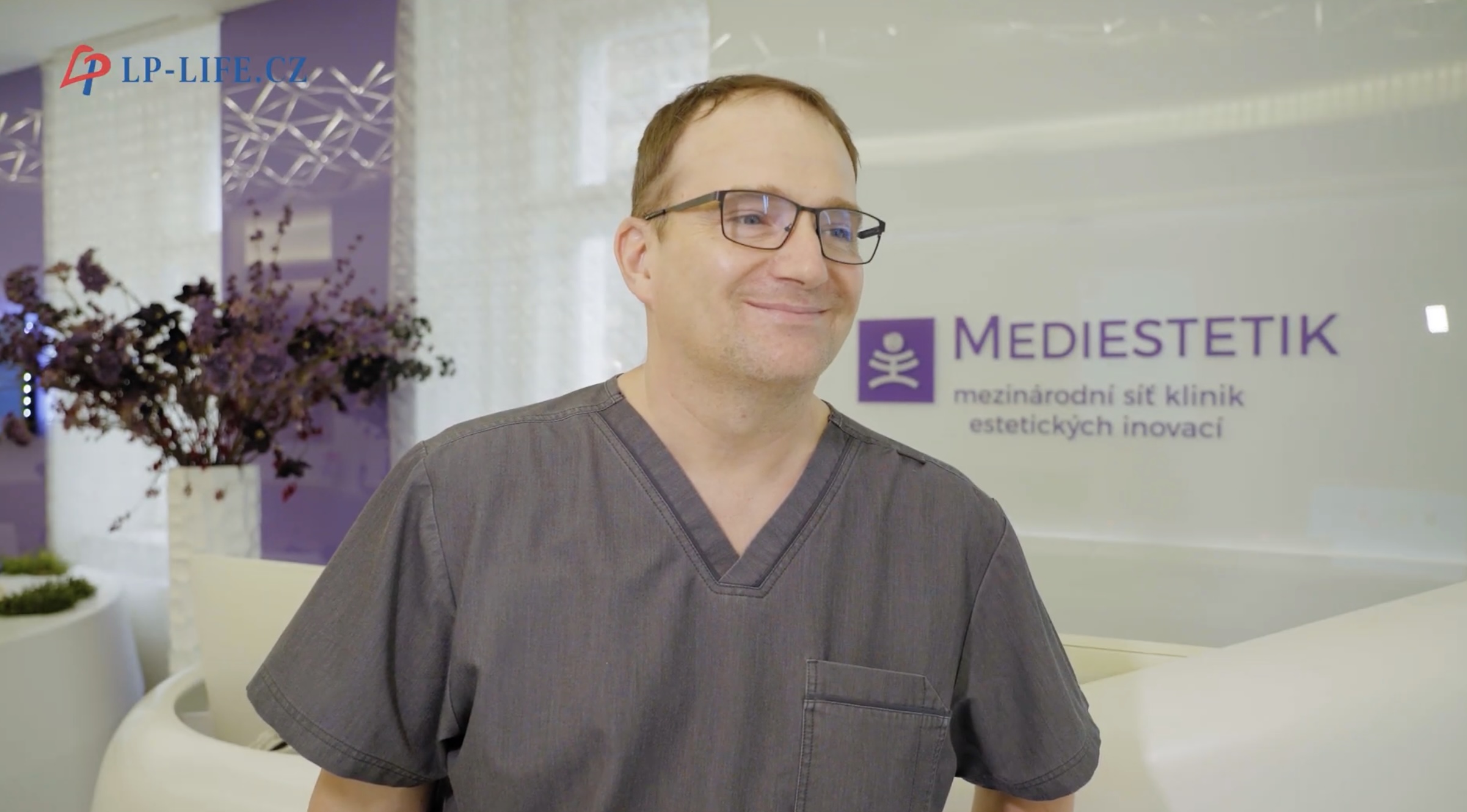
The conversation with plastic surgeon Martin Fiala from the Mediestetik clinic was not just about aesthetic procedures. It was about a return. About women returning to themselves - after childbirth, after losing self-confidence, after years when the body and soul gave space to everyone else. We talked about Mommy Makeover, a comprehensive approach that does not promise transformation, but a gentle rediscovery of oneself. Martin Fiala approaches his work with humility, sensitivity, and deep respect not only for beauty, but for the life journey that women go through. And that's where the strength of his approach lies. "It is wonderful to watch how a woman blossoms after the procedure," he says. And you believe him. Because he really means it.
Recently, the modern concept of mommy makeover is increasingly being discussed in plastic surgery. Can you tell us more about it?
The mommy makeover concept is a relatively modern affair. It's about allowing a woman to return to the form she was in after childbirth and breastfeeding - or as close to it as possible. We most often combine several procedures - either within one operation, or shortly after each other - so that the overall recovery period is as short as possible. This includes abdominoplasty in some of its forms, breast adjustment (augmentation, modeling or their combination), liposuction in problem areas and sometimes also correction of intimate areas, if they were affected by childbirth or hormonal changes.

How soon after childbirth or breastfeeding can a woman undergo a mommy makeover procedure?
From a medical point of view, the optimal time is approximately 12 months after childbirth or cessation of breastfeeding. In some cases, it may be possible to perform the procedure after just 6 months - it depends a lot individually on the woman's condition and how fit she is. However, we generally recommend a range of 6 to 12 months, ideally those 12.
What is convalescence? Isn't it longer and more demanding considering the woman has gone through pregnancy, childbirth and breastfeeding?
If more procedures are performed at once, convalescence can be slightly longer, but the overall healing time is significantly shortened. Of course, it is necessary to consider that the woman is after pregnancy and breastfeeding, which can affect her condition. That is why we always assess everything individually. Our goal is for the woman to undergo the procedure at a time when she is physically and mentally stable and in a phase that is safe for her.
What types of abdominoplasty do you perform at your clinic?
At our clinic, we offer practically all types of abdominoplasties - whether it is a mini abdominoplasty, a simple abdominoplasty, abdominoplasty with diastasis suture, or a combined abdominoplasty with liposuction.
Is breast shaping or augmentation more common as part of the Mommy Makeover?
I think it is very close to 50/50, but breast shaping is slightly more common. This is probably because shaping is often needed even in the case of augmentation alone.
And what about intimate areas? Does the concept also apply to them? Which procedure do women most often undergo in this area?
In the area of intimate parts, we most often perform labiaplasty, or some minor support - let's say augmentation or minor lipoaugmentation.
There are a lot of inaccuracies about liposuction among laypeople. What is liposuction and how does it work?
Liposuction as such has a reputation among laypeople for simply sucking out fat with a small tube. It's not like that - it's a surgical procedure like any other. Metal tools are used for this, which are inserted under the skin, where they disrupt and remove fat tissue using suction and a sharp part. So it's a standard surgical procedure, with all its advantages, but also certain risks and specifics.
Is the procedure painful?
Liposuction, if properly performed and the right anesthesia chosen - whether local or general - should not be particularly painful. It is virtually painless, except for the actual numbing.
How does convalescence proceed?
Convalescence takes several weeks, during which the final shape is actually settling. First, it swells, then it gradually begins to deflate, subsequently there is a remodeling of the subcutaneous tissue, shrinking, collagen fiberization and actually finalizing the shape. It really takes several weeks.
What areas can be treated with liposuction?
Purely hypothetically, fat can be suctioned off everywhere where it is, but realistically this is done most often in the areas of thighs, abdomen, back or arms.
Will I have scars after liposuction?
After liposuction, you will have scars, but they will be very small. They will look like a completely miniature mole or will be even smaller. Over time, they should fade to the point that they will not be noticeable in the texture of your skin. Of course, with very close inspection, you will find them, but they are typically not disruptive.
Does liposuction solve cellulite?
Liposuction can sometimes have a positive effect, but it is quite without guarantee, so it cannot be relied upon.
Are there any risks to liposuction? Can something go wrong?
As I mentioned, it is indeed a surgical procedure like any other and carries similar risks as excision or tooth extraction. There may be some complications, which of course we would try to manage, but it is not very common.
Is liposuction a solution to overweight?
Liposuction is definitely not a solution to overweight. It should rather be a sort of finalization procedure that will refine what, in an ideal case, can no longer be lost weight or trained away.
Is it true that fat from the abdomen and hips is not as good quality as fat from the area of the inner and outer thighs?
Many plastic surgeons who deal with fat transfer say that there is a certain difference. In fact, the fat from the inner knees is considered the highest quality. From the point of view of stem cell content, it's a bit of an academic debate. The lower abdomen should not even have the same quality as, for example, the inner knees - so from our point of view it's more like, I would say, plastic Latin. But it's true that the inner knees and the lower abdomen probably have the highest quality fat.
Can liposuction and breast modeling with own fat be done at the same time?
It is actually a condition, let's say, in the case of modeling with your own fat, because that fat has a certain limited lifespan. If we didn't transfer it to the tissue right away, but for example to some kind of tissue bank, the fat would die. Because it's live tissue that we're transferring. So yes, it is also desirable.
Is the fat absorbed in the supplied area? Does this procedure need to be repeated?
The fat is absorbed almost after each transfer. It is stated to be something between 30 and 80%. It probably depends on the technique, skill and quality of fat. Therefore, it is logical that the procedure must be repeated. It is most often repeated multiple times - twice, three times, four times, roughly in this manner.
Which procedures can liposuction be combined with in the Mommy Makeover, and is it suitable?
It is suitable and most often we combine it with breast augmentation surgeries, where we can perform a combined procedure. Liposuction can also be used in minor breast shaping, where we need to add volume to the upper quadrants. Similarly, liposuction itself, without the use of fat, can be performed during abdominoplasty, where it beautifully contours the sides, which the surgeon can't reach at the moment of surgery. In limited cases, there is no problem using it even in the adjustment of intimate parts, where the fat is used not so much for enlargement, but rather for refreshment, highlighting contour, and rejuvenating this area.
What surgeries are most common in men combined with liposuction?
The most common procedures in men are gynecomastia and abdominal surgery, i.e., abdominoplasty. In gynecomastia, which means removing the enlarged gland, liposuction is a great advantage because it allows us to adjust the area around the gland - that is, excess fat. In addition, the tissues of younger men can retract well, and the results are then very favorable, let's say very nice.
Which plastic surgery do you think is the most effective and why?
I think that from my perspective, the most effective operation of the upper and lower eyelids is because there is a huge cost-benefit - not only financial, but also in terms of the strain on the patient. This means low strain, great effect, and high reliability of the procedure.
What operations did you perform last and which are awaiting you in the near future?
As the last, I performed breast modeling and upper eyelid surgery - that is now. And in the foreseeable future, I am expecting plastic surgery for pediatric patients, and at the same time, I am awaiting abdominoplasty and lipotransfer for adult patients. This means, in addition to the pediatric procedures, it is essentially what falls into the group of Mommy Makeover.
You mentioned that you also perform pediatric procedures. Could you elaborate on this topic?
In my practice, I primarily deal with facial clefts, which are congenital defects in children, and also two other congenital defects that fall under plastic surgery at Children's Hospital in Brno. At the moment, a neonatal lip reconstruction awaits me - an operation of a patient who is born and operated within 28 days after birth. In our case, most often between the 6th and 15th day of life.
Is such an operation mentally demanding for you?
Cleft lip and palate are diagnoses with a great variability. There are surgeries that are rather routine – these are minor procedures with a predictable and nice result. And then there are cases that are very complicated and pose a real challenge to the doctor even when they already have rich experience and have performed many of these interventions. These are situations that are literally on the edge, when you say to yourself: how to do it as best as possible so that the result stands up.
With such procedures, it's really beautiful that you can help children who are born with such a defect or disease - not only medically, but also in terms of appearance. This means they don't have to be dissatisfied with themselves and can lead a completely normal and content life.
Yes, definitely. It's a question of how then children are integrated into the group, how they socialize also in personal life, how their soul can develop. Because the pressure would be enormous if the defect remained unresolved.
This is beautiful work. We certainly thank you for doing it and for devoting yourself to it.
I am grateful that I can do it.
Tell me, why should one book a surgery specifically with you?
Because we provide care in high quality. We always try to meet our clients halfway and find an individual plan specifically for them - the best path, which may not always be the one he imagines, but very often we get to it together. And because we, I personally am, very gentle with the body. We always try to strain the organism as little as possible, even during aesthetic performance, and yet achieve the best result.
Thank you, we will definitely order that.
Thank you, gladly. We look forward to it.
Fast confession:
What do you imagine when you hear female beauty?
What catches your eye in a woman first?
Where do you get inspiration from?
Natural or enhanced?
How do you stay in shape?
What book do you have on your bedside table?
Your biggest vice?
What does nobody know about you?
Where do you feel good in the world?
Faith in God or in yourself?
Is there anything you regret in your life?
The most amazing thing that happened to you last year?
What investment has paid off for you in life?
What other profession do you admire?
What does luxury mean to you?
What would you ask me?
Interesting question. I guess I wouldn't choose another career - I would stick with the one I have now.