"Bombing for peace is complete nonsense," says activist Yara Abu Aataya.
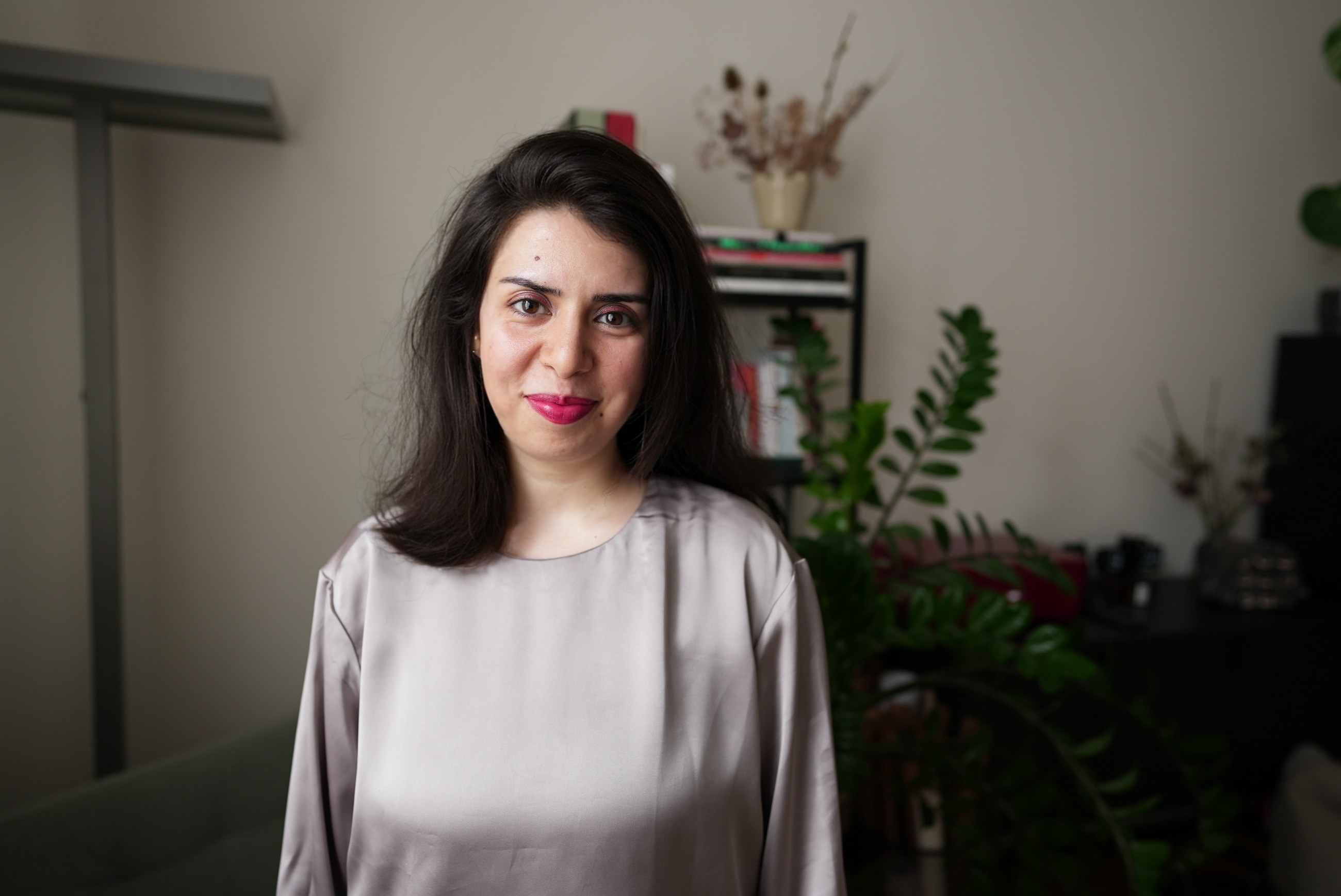
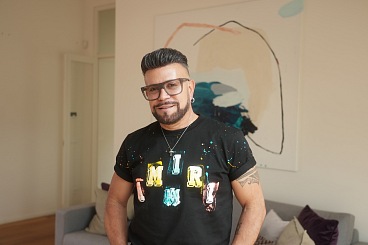
Kindness, openness, and the anger that drives her forward. Designer and activist with Czech-Palestinian roots, Yara Abu Aataya speaks openly about what it’s like to grow up between two worlds, why she sees activism as a necessity, and what it’s like to become a voice that part of society does not want to hear. In the interview, she touches on questions of identity, stereotypes, and media images—and candidly expresses her views on what is currently happening in the region of Southwest Asia and North Africa and the role the West plays in it.
When someone asks you where you're from, how do you answer? Do you feel more like a Czech or a Palestinian?
I usually say Czech-Palestinian because although both of my parents are Palestinians, I don't know anything other than Czechia and Prague, so it's really a kind of mix.
How has your dual identity shaped you?
I think at the beginning it was a terrible clash of the two identities. It was very challenging – at school, it was really about perceiving that different rules work completely differently in one culture compared to the other.
I feel that it shaped me a lot later when I realized that it's not wrong to be Arab or Palestinian, because I suppressed that part of myself a lot until I was eighteen. Until I got a Czech passport, I felt like I couldn't actually be that Arab and couldn't show any Arab traits.
Even though I look the way I do, and of course it was often suggested to me, nobody considered me Czech. It made me even more determined to prove to them that I am.
You are both an activist and a designer. Was this always a connected world for you, or did you start focusing on one thing later?
I feel that the activism emerged gradually. Even in high school, at the grammar school, I was partially involved in it – I was the director of One World at Ohradní.
I think that's where the need to help, or rather the capacity to address issues other than my own, began to form in me. It gave me the feeling that it had a greater purpose than just going to work and doing things that please me. I felt that what I was doing should have some broader impact.
Then it seamlessly transitioned during college to a phase where it didn't make sense for me to keep talking about it — I expected people to be sufficiently informed, to already know about it and not drain me as a source of that information.
I returned to activism in 2021 when Israel attacked Gaza, and later again after October 7th and the Israeli retaliation. It wasn't entirely a coincidence, more of a convergence of circumstances, that I started to engage in it so actively.
And thanks to being cut from Czech Television, I actually got much more media exposure because it went viral. I wrote about it on my social media – about being cut from Czech Television, even though they invited me there.
And because it was cut and went viral, more and more media began to invite me.
So if it hadn't happened, I wouldn't be focusing on it so intensely.
And do you know why exactly they cut you out?
They cut me out and informed me two months later. It was all actually compiled as an Israeli narrative of what happened to the Israelis, but without the context of what is happening in Palestine, what is happening to my family.
I think it was very interesting to see that yes – we want to invite and listen to the Palestinian voice, but it doesn't suit us as much to have Palestinians seen as also suffering.
Because in that interview, which lasted maybe 40 minutes, I didn't say anything controversial. I said things that have long been confirmed – that Israel uses illegal white phosphorus on the civilian population and so on.
Your work ranges from graphics to glass to light installations. What fascinates you most about design?
I think it's communication with people. Even though it's the most challenging discipline – for me, it's the human factor, which is always incredibly different. It's fluid work with what a person expects and wants.
It's some work with the client, but at the same time a certain beauty. The ability to transform thoughts into something physical. Light, for example, is not physical, but it can be worked with through physical objects. When I created light scenes at electronic events, it was mostly connected with architecture. That's my background – we built small objects and illuminated them.
So for me, it's a kind of play with things that I probably enjoy together.
Do you feel that Czech society understands what is happening in the Middle East? In the SWANA region, Southwest Asia and North Africa?
I think it's extremely difficult to answer this question because, on one hand, it's very challenging for them to understand because they imagine... How to describe it? So maybe I'll start right from the beginning.
I think Czechs generally have a completely different perspective on the world outside Europe. And this can apply to Japan as well as Southwest Asia. But I feel that this division into "us" and "them" is what makes the problem a problem.
I perceive that the media play a big role in the dehumanization of Arabs in general, and this has been the case since September 11, 2001. I think the situation has worsened since the invasion of Iraq, but the narrative still operates in exactly the same way.
The USA is portrayed as going to Southwestern Asia to create democracy, but bombing to create peace somewhere—that's complete nonsense.
So from my perspective, people in the Czech Republic don't understand the issues of Southwestern Asia, because the media manipulate how the situation really is and what precedes it. And also because the USA is constantly portrayed as "the good guy."
Have you encountered hate and threats because of your opinions?
Unfortunately, since October 7th, given that I tried to explain what it's like on the other side, and given that I have family in Gaza, yes – I have encountered threats. I received emails that came regularly, including death threats against me or my family. They were insane emails, which I eventually made public.
I asked the police to look into it, but they refused, saying they didn't have enough evidence, which I think is more of a way to avoid dealing with it. It was sent via email and can be traced back.
So no one is addressing it. Fortunately, it stopped happening—perhaps a few months ago—but until then it was very intense, unfortunately.
Have you also faced accusations of antisemitism?
Yes, regularly. It's actually ironic when you consider that both Jews and Palestinians are Semites, so being an antisemite doesn't make much sense.
At the end of February, the USA and Israel launched extensive strikes on Iran and the region. Did it surprise you that the conflict reached this stage?
I think I actually answered this question in the previous one – it doesn't surprise me that the world accepted this. It's not something that should now be communicated in a way that the USA is going to create democracy in Iran once again.
I'm not saying the situation there is ideal, but it's not ideal in the USA either. The number of homeless people and the level of poverty in the USA are not addressed, and instead, Israel is financed first and foremost, which creates a complete imbalance in the Southwest Asia and North Africa region.
So for me, it's not surprising and I think it's also a way to distract us and create confusion. Because at the moment when confusion arises in us, we stop paying attention to it and stop perceiving that something is wrong.
So the timeline of these events - when the Epstein files were released or, for example, the kidnapping of the Venezuelan president - these are, in my opinion, all things that are meant to create, in my opinion, a certain confusion, so that we stop addressing these issues and actively speaking out against them or doing something about them.
So, do you think the world is more striving for a balance of power between major nations rather than having peace everywhere?
Yes.
Do you encounter the opinion that artists shouldn't express themselves on politics and wars at all?
I think that... I think it has been mentioned several times, even by my friends - that there's not really a way out if I pursue it, that I won't change anything, and that it would be better if I focus more on design. And that through design, I might be able to express something political.
But I think most designers tend to stay silent. It's something they gradually learn, and I feel that generally, in Czech society, people aren't accustomed to protesting in general – going to the streets when they don't like something.
How many times have people actually taken to the streets when Macinka threatened the president, the Pro-Life movement? Apart from November 17th, I really can't recall any other events, and that's really very few. When you look at the world around us, people take to the streets much more often.
And it's something that bothers me a lot – that it's not automatically perceived as something natural here. That if I don't like something, I do something about it.
I feel that people here have resigned themselves to the idea that they can change something.
When you disconnect from the news and social media, what brings you joy?
Boxing, music, friends, cat. Walks.
If you had the chance to tell people around the world one thing about Palestine, what would it be?
I would say: I wish for a free Palestine. I wish for Palestine, so she could be free. Not "so she could be free," but "so she is free." Wow, that would be beautiful.
Thank you very much for the interview.
Sources: editorial team, interview
Fast confession:
Three words that best describe you?
Prague or Berlin?
Silence or discussion?
Tradition or the modern world?
Glass or graphics?
What gives you the most hope today?
The biggest myth about Palestine?
The biggest stereotype you encounter?
Activism – is it a necessity or a trend?
What always makes your day better?
Without what won't you leave the house?
The book that influenced you the most?
What can immediately upset you?
What always makes you laugh?
And what would you ask me?
Probably peace.