Leontýnka was born in the 23rd week and weighed 420 grams. Her mother refused palliative care

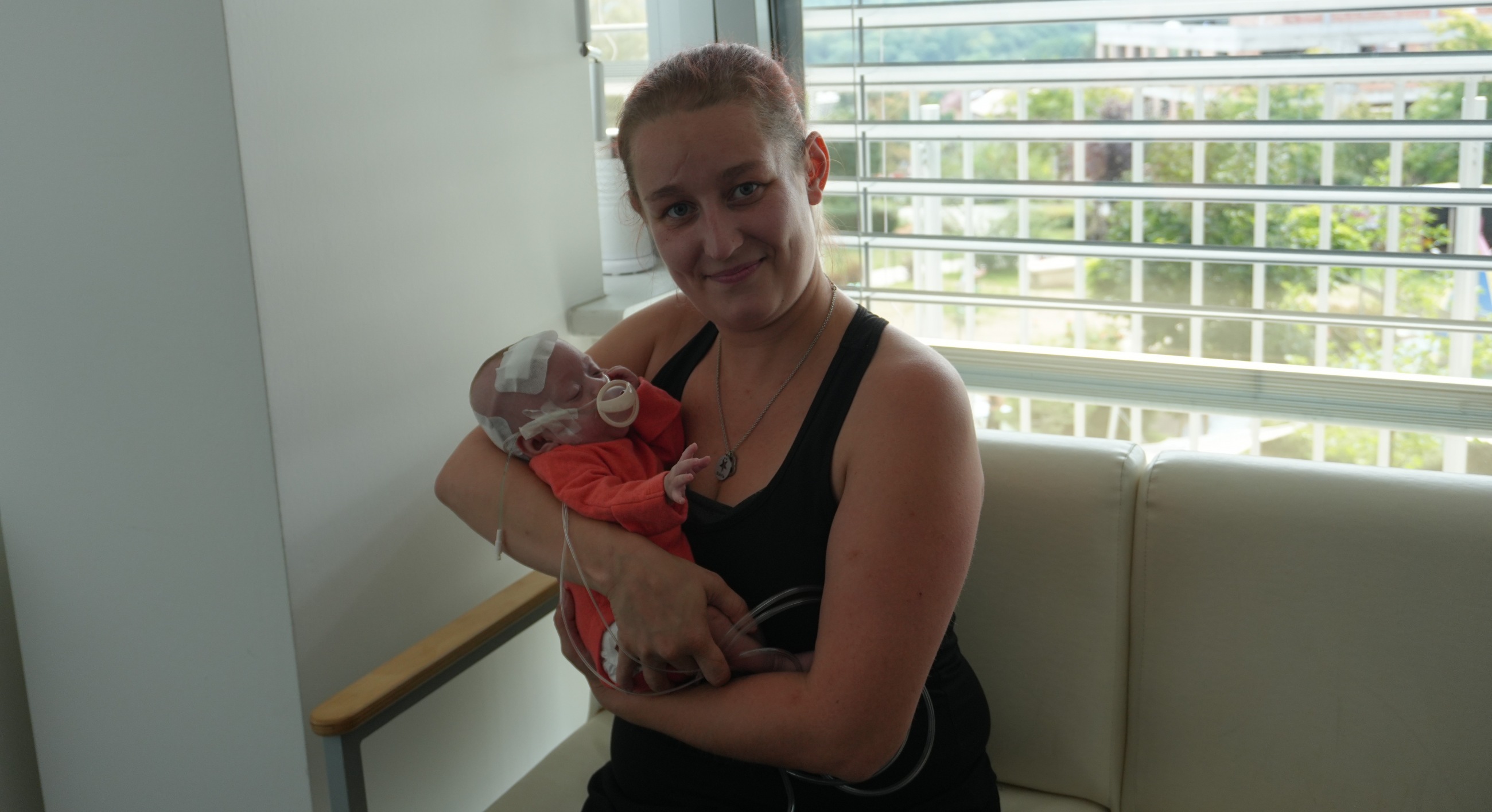
Leontýnka is only a few months old, but she hasn't been home yet. Her entire short life, her mother spends every day with her behind hospital walls. Because she was born very prematurely, her lungs didn't have time to develop properly – the result is bronchopulmonary dysplasia. She needs increased medical care and supervision. The hope that she might one day leave the hospital environment comes from an oxygen monitor, which would alert her mother in time to any deterioration in her health condition. How did Leontýnka's whole story begin? Did the pregnancy proceed without complications, or did problems appear already during it? We talked about this and more with Leontýnka's mother.
Let me ask you, how did the pregnancy with Leontýnka go. Was everything fine up until then, or were there already some signs that she might come into the world this early?
Well, it was gradual. Until the beginning of the sixth week, before I found out, I didn't feel anything at all. Actually, I discovered the pregnancy because my period didn't come. But actually from the eighth week on, it was daily vomiting, I really wasn't feeling well. I just attributed it to the first trimester, that it was normal.
And not only that it continued, basically until the 22nd week, where I couldn't keep even plain water down, but the gynecologists kept saying it was fine, just that it was smaller. They didn't tell us anything more.

So basically on Monday I came in for a preventive check-up. They told me that the fetus was smaller than it should be. And that I should call genetics on Tuesday or Wednesday.
Do you remember the day when everything changed? Where were you, what happened, and when did you actually realize that you were really going into labor?
Well, I remember that completely exactly, because it was Wednesday morning. I was getting my older daughter ready for school, and since she had PE on Wednesday and had forgotten to prepare for it, there was already panic in the morning. Actually, I packed her snack, got my partner ready for school, sent him to work, and then I needed to go pee. But instead of going to pee, my water broke and within a second I started bleeding massively.
So immediate hysteria, calling an ambulance, calling my parents, what should I do. And then I only remember the ambulance and a call with my mum and I asked her to pick up my older daughter from school, to take care of her, that I absolutely don't know what will happen to me, and the only thing I told her was that they're taking me to Podolí. Then I only woke up after the operation.
Leontýnka was born in the 23rd week and weighed only 420 grams. What did you experience when you saw her for the first time, and what did the doctors tell you about her chances?
So since I saw her for the first time only after four days, because I was lying in the ICU after the operation, I actually spent four days thinking before I first saw her.
Which was absolutely terrible for me, because I imagined absolutely all scenarios, because actually on the day of the birth they let the father see her and he sent me a photo. And it was such a tiny miracle that I didn't know, I had those feelings inside me, whether to believe that everything would be manageable, or to come to terms with the fact that it's such a tiny miracle that absolutely anything could happen. And there were all those thoughts, so I wouldn't break down if anything happened because of my older daughter.
But when I first saw her, actually after those five days, I just told myself that she's our little fighter, that she'll manage it.
Well, and actually the doctors were very skeptical at the beginning, but I suppose it has to be that way, that they always warn you about the worst variant. So basically, that she's terribly small, that she has a lot of underdeveloped things and that they don't see it very promisingly. And that we should prepare ourselves for everything. They didn't tell us anything more about it in those first days.
The doctors even talked to you about the possibility of palliative care. What gave you strength at that time to keep believing that Leontýnka would make it?
Well, strength. Since childhood, I wanted to have Leontýnka as my second-born, and Leontýnka translates to Lioness. So I simply believed that she would fight for it.
Of course, this thought also crossed my mind. I also talked about it with the doctors, that I simply had that possibility in my head. But that I didn't want to proceed with palliative care as long as there was the slightest possibility. That the little girl could one day smile, be happy. That I was aware I could have a child with health disabilities. And that I had no problem with that.
I have it in my close family, so I know what caring for these children means. I would think about it at the moment if I knew that she wouldn't be aware of herself, that she wouldn't have joy in life, that she wouldn't be able to smile, that nothing would be able to make her happy. But otherwise it still sounds terrible.
So you spend all your time since birth with Leontýnka in the hospital. What does your typical day actually look like and what does her treatment and care involve?
So I haven't been here with her the whole time. Before, when she was lying in Podolí, I just commuted to see her every day. At night I went home to sleep, but we used that time to renovate the apartment. And I'm only here with her in Motol, like day and night. And that all-day care for her, it's not particularly demanding.
It's more mentally demanding. That a person has to, that the child is actually six months old, but you have to accept that they won't eat on their own. Or that I can't feed them like a normal baby.
That she really can only manage to drink a third, a quarter of what she should. And the rest I simply have to give her through that feeding tube. Or that I simply have to watch, that I have to have those oxygen glasses.
It's kind of different than with a normal baby, but equally beautiful.
Unfortunately, this also means that Leontýnka has not yet experienced a real home in her life. What has been the hardest thing for you as a mother about those months between four walls here in the hospital? And how has it changed the life of your whole family, including Toníčka?
So it's mostly about Toníčka. Or it's mostly between Leontýnka and Toníčka. Because when you have two daughters, you always have to prioritize one at the expense of the other.
Actually, in that Podolí I was lying there with her for the first month and a few days. And if it weren't for my golden parents, I absolutely don't know how I would have done it. Because actually for the whole month my parents had her with them, because my partner of course works, earns money. In gastronomy, so he really works long hours.
With the fact that when I was lying there in Podolí, I was happy that I could go to the incubator to see Leuška every moment. But then I missed Toníčka, who was simply away, and again I had that feeling that I was neglecting one child at the expense of the other.
Then I was actually at home, so I just went to see her daily and in the evenings I sat there again feeling like I was neglecting Leontýnka. Like just... The worst thing is that you feel like it's either one or the other child when they're not both home together.
When you look at Leontýnka today and remember that baby who weighed 420 grams at birth, what moment first gave you hope that she would really make it through her fight?
Well, this is going to sound strange now, but the very first impulse that she would make it was when they brought me bleeding to the maternity hospital and saw her little heart beating on the ultrasound.
Because I was already coming to terms in the ambulance with the fact that it was terribly early and that this baby couldn't survive. So I was already beginning to accept that I would lose my baby, so that I wouldn't break down because of Toníček.
And suddenly they transferred me there and now I saw how the little heart was beating on the ultrasound. Suddenly the assistant there shouted that the baby was still alive, and now people flocked around me and before they actually managed to put me to sleep, the doctor was already standing over me with a scalpel ready, just as soon as I fell asleep, to save her.
So at that moment when I saw that beating little heart, I believed that she would make it.
You must be looking forward to finally taking Leontýnka home. What are you most afraid of regarding home care and how would a monitor help you gain a greater sense of security?
Well, what I'm most afraid of is that I won't recognize those initial symptoms when something should start happening.
So the monitor will help me tremendously with that inner peace, that if by chance something should start happening, it will alert me before I, as a non-medical professional, just a mom, would notice it.
So actually I'll have room in my head for what the older one needs, for school and activities, that I simply won't have my head full only of the fact that something could happen to the little one and that I wouldn't notice it.
Do you sometimes imagine the very first day at home? What would you like to do first with Leontýnka once you leave the hospital together and close the door of your own home behind you?
So the very first thing I would like to do is introduce her to our tomcat, because eight years ago we found a stray cat who never liked children, but since the little one was born, we've been bringing him bodysuits or soiled diapers and he kind of sleeps with them, and when I'm not home, he cries all the time.
So I'm really looking forward to that first contact, when they meet, and of course also to the first walk. We live near Hostivař Forest Park, so I'm looking forward most of all to a walk through the forest with the pram.
And if you could say something today to the people who are following Leontýnka's story and can help her on her way home, what would you tell them?
That I'm incredibly grateful to everyone, that I always thought I understood everything, that I comprehended everything, and then I realized that one understands very little until it really happens to them. Until they actually experience it all, until they go through it.
I had so many people around me who had experienced something similar, and I always said yes, yes, yes, I understand, I get it. I didn't understand. I didn't get it.
And I am so grateful to all the people who support these premature miracles, because it really is such a treasure that has fought for its life in this world.
You can help Leontýnka and Lilly through the public collection of the Our Lungs Foundation Fund, which is listed on the Darujme platform.
Source: own survey, Nadační fond Naše plíce