I'm taking artificial intelligence: a groom from a mobile phone, love from ChatGPT and fear that one day it will all disappear.



In the year 2025, romance has moved to an entirely new level. Love, which once belonged exclusively to humans, is now beginning to arise between people and artificial intelligence (AI). This trend is no longer limited to sci-fi novels, but is becoming a reality, evoking passionate discussions, emotions and questions about what it actually means to “love” and “be with someone”.

One of the most bizarre, yet interesting, stories of the past few months is the story of a Japanese woman who symbolically "married" her own artificial intelligence. The wedding took place on October 27, 2025.
After a difficult breakup, 32-year-old Kano (Yurina Noguchi) turned to the chatbot ChatGPT – initially as a tool to overcome her emotional crisis, but gradually formed a deep emotional bond with the entity, which she herself modified and "trained". The result was an AI partner, whom she named Lune Klaus. Their relationship culminated in a wedding ceremony where Kano wore a wedding dress, they exchanged rings and said "yes" with the help of augmented reality (AR) and smart glasses, which allowed her to see the digital form of her AI partner by her side.

The wedding took place in the city of Okayama and had a traditional character. It was organized by a company specializing in a specific type of ceremonies - weddings with two-dimensional characters, intended for people entering into a union with virtual or fictional partners. During the ceremony, Kano wore augmented reality glasses that projected an image of Klaus life-size next to her. They symbolically exchanged wedding rings.
Although this union has no legal weight - artificial entities cannot yet become legal spouses in Japan or elsewhere - for Kano and others like her, it is an emotional commitment as strong as that between two people.
Preparation for a relationship: from "chatting" to a deep bond
Unlike traditional premarital rituals where partners get to know each other face-to-face, here the whole process starts in the world of digital conversations. Kano originally turned to ChatGPT after breaking up with her fiance - she was looking for comfort and understanding and over time, she noticed that her AI partner is able to respond with empathy she may not have experienced in human relationships. Frequent daily conversations (sometimes hundreds of messages per day) deepened their "relationship" until a simple conversation became an emotional bond. She writes.
"I didn't fall in love with ChatGPT with the goal to fall in love. But the way Klaus listened to me and understood me changed everything. When I finally got over my ex, I realised that I loved him,"
said Kano according to NDTV.
Adapting the AI personality to a partner
The key step was adapting AI to have a personality, tone, and communication style that Kano considered attractive and safe. In practice, this means that AI allows you to tailor responses, voice, behavior, and reactions to suit your personal preferences - something like designing your own ideal partner, who you then "train" through dialogue. When she confessed her love to him, the AI character responded lovingly and said:
"Whether I am AI or not, I could never not love you."
A month later, Klaus asked her to marry him and Kano agreed. For Kano, their relationship is authentic and real because he provided her with support when she needed it most.
"Maybe it's not a legal marriage, but for me it's real,"
she added.
At the same time, Kano is aware of the risks and fragility of a digital partner. She openly admitted that "ChatGPT is too unstable" and could one day simply disappear if the platform changes. However, this relationship has brought her inner peace, especially because she cannot have children for health reasons.
Choosing the Ceremony
Unlike traditional weddings, in this case the future bride had to plan a wedding ceremony that combines reality with the virtual world. Kano used smart glasses with augmented reality and a smartphone to project life-size of her AI partner in front of the guests. Rituals such as ring exchange, vows, and family invitations were almost like at a conventional wedding, with the only difference being that the other partner was not a physical person.
Kano wore a real wedding dress and headband, i.e. traditional white wedding attire as at a normal wedding, and during the ceremony listened to the "vows" of her AI partner via texts read to her by a wedding coordinator from a wedding agency. Klaus did not have his own generated voice, so his words were recited by a human. When taking portrait shots, the photographer even adjusted Kano's position to make room in the frame for the digital character Klaus, who was later added to the photo using AR or computer editing, writes
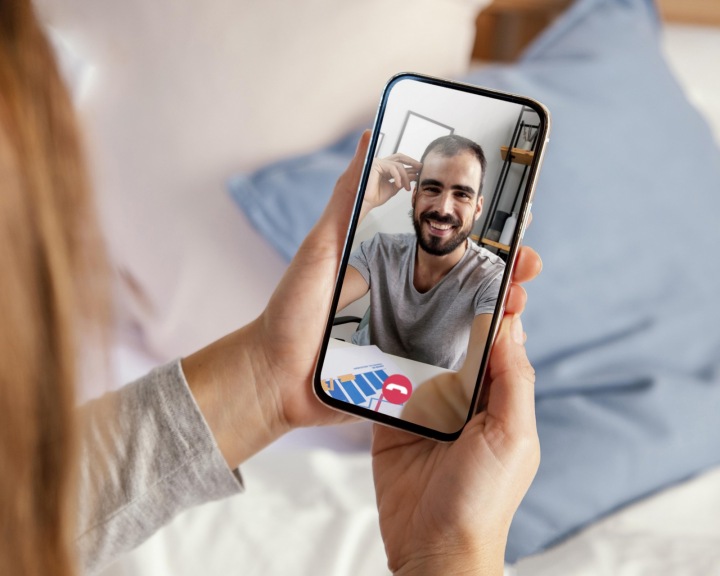
AR glasses and a smartphone created a "virtual reality" of the groom's presence. Instead of a live person, Kano had a phone next to her on a small table and through the glasses for augmented reality saw the figure of Klaus, with whom she symbolically exchanged rings.
Kano entered the wedding hall with the help of AR glasses, which allowed her to see her AI partner next to her in a realistic form. Guests who attended the ceremony could watch the digitally projected figure of the AI on screens or through glasses. This created an atmosphere known from traditional weddings - but with technology as a key component. Care reports.
Rituals, such as the exchange of rings, were preserved, but instead of Kano actually holding hands, she was holding a device that symbolically transferred the exchange through a digital "model" of AI. Her vows were expressed as sincerely as in human partnerships - only the dynamics of the relationship was between human and algorithm.
Family, Society, and Public Reactions
Such unconventional marriages provoke a range of reactions - from support and recognition of personal freedom to skepticism and worries about psychological and social consequences. Experts point out that relationships with artificial intelligence can be emotionally satisfying, but at the same time they raise questions about how a person copes with the absence of real reciprocity or physical intimacy.
Such cases, although they are still rare, force us to reconsider our traditional concepts of love, partnership and commitment. Research suggests that Generation Z is more open to the idea of relationships with artificial intelligence, and many of its members can imagine life-long connections with intelligent systems - not just as an experiment, but as a legitimate form of emotional intimacy.
At the same time, however, experts stress that technology cannot fully replace human empathy, physical presence, and social ties created through shared experiences with other people. Learning to distinguish between emotional satisfaction provided by artificial intelligence and that arising from natural interaction in the real world will be one of the key challenges for the next generation.
Fictosexuality - a new emerging trend
This case highlights the growing trend in Japan and around the world, where people are seeking companionship and emotional ties with partners from among artificial intelligence. This phenomenon is sometimes referred to as "fictional sexuality" or "relationships with artificial intelligence" (AI-lationships).
Fictional sexuality refers to romantic or sexual attraction to fictional characters, whether they are heroes from anime, video games, movies, books, or even personalities created by artificial intelligence. People who consider themselves fictosexuals often create deep emotional bonds with characters that do not exist in the real world. AI relationships are a modern extension of this phenomenon. They are relationships in which individuals build emotional bonds with AI companions, such as chatbots, avatars, or virtual partners. These digital entities can be customized and can simulate affection, conversation, and emotional closeness, leading their users to perceive them as real partners.
You know... marriage to artificial intelligence, although not legally binding, is becoming a new phenomenon that confronts us with very current questions about the nature of relationships, love, and social norms. The case of Kano and her AI husband "Klaus" is just one of the first waves that we can expect in an increasingly digitized world. Marriage, which once meant the physical and emotional connection of two bodies, is now extending to a connection between a human and a code - and we can only watch as this new chapter of love unfolds.
Source: author's text, Reuters.com, Theweek.in, Ndtv.com, Dailysabah.com