Daniela suffers from a rare disease: I was very lucky with my doctor. I'm glad the fund helps other people

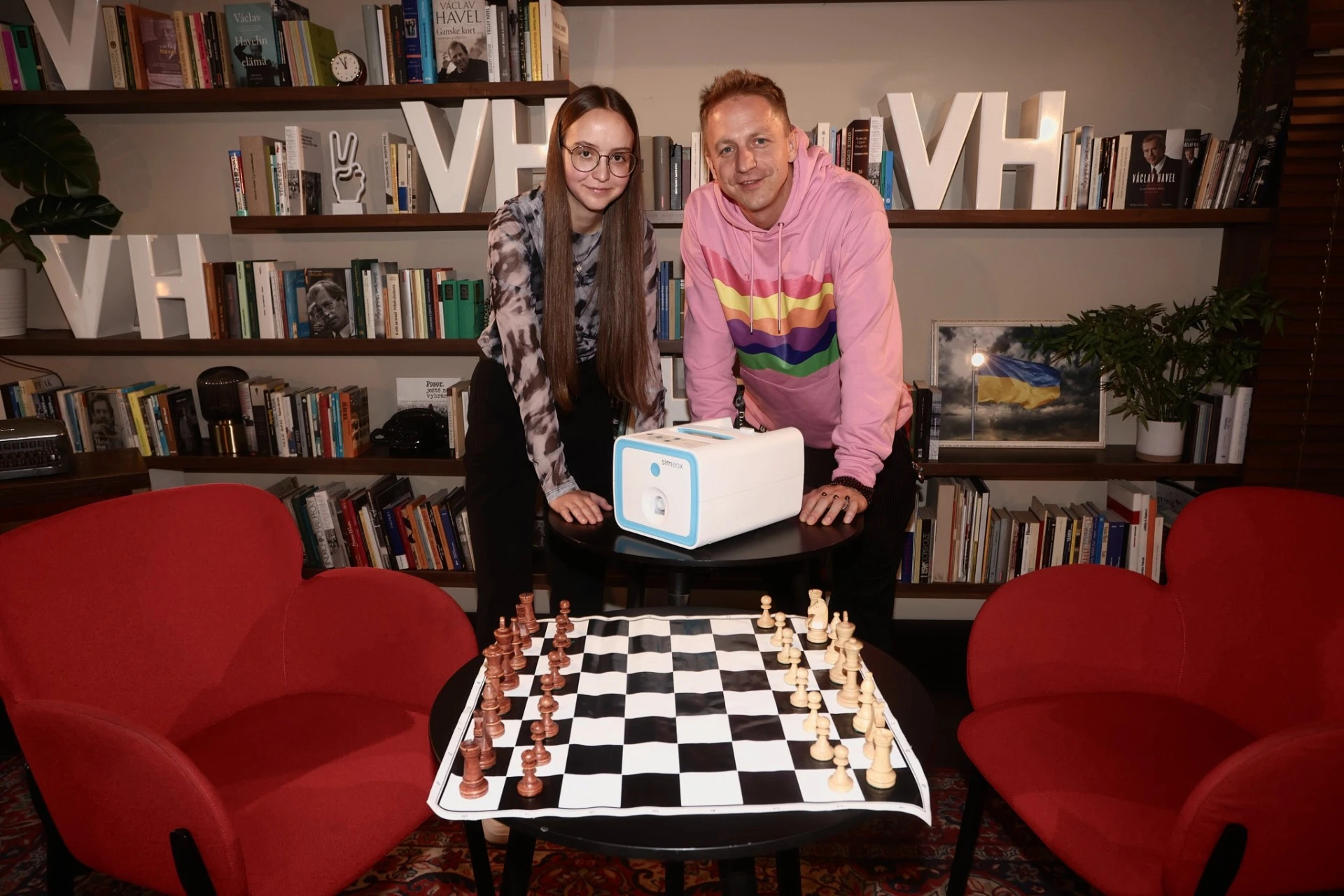
At the age of eleven, she was diagnosed with primary ciliary dyskinesia, which causes Daniela chronic cough and respiratory infections. The foundation Naše plíce donated her a so-called cough assistant – a device called Simeox, which was presented to the passionate chess player by Tomáš Klus. What does she say about meeting the famous singer? How exactly does the device help Daniela? What are her experiences with doctors and how does she evaluate the approach of health insurance companies?
Daniela, how exactly does the Simeox device help you?
It helps me clear my lungs and get mucus out from the lower part of the lungs, which cannot be done with regular saline solution inhalation. And I also feel that I get sick less often.
So how many times a day do you use it? And do you have to take it with you when you're away from home for a longer time?

Usage varies depending on how congested I feel, but usually it's twice a week. If I were going away from home for a longer time, I would take it with me. I can also use mechanical aids and exercises, but they are nowhere near as effective.
When you compare your life before the collection and after receiving the device – what do you see as the biggest positive change? How much has your life actually changed?
Using the device improves my breathing and I then feel better overall. It also helps me not to worsen my overall lung capacity, which is lower than that of a healthy person.
Has Simeox brought you, besides the health effect, also a greater sense of freedom or security?
I hope I won't have to go so often for bronchoscopy, or lung cleaning.
The device was handed to you at the Václav Havel Library by singer Tomáš Klus. What were your first feelings when you found out that it would be him who would hand you the device?
I don't listen to his music as a singer, but I liked the fairy tale The Secret of the Old Bambitka, in which he acted. The handover itself pleasantly surprised me.
And what did your friends say about it, for example? Was there a bit of that "healthy" envy? After all, he is an idol of many girls. So perhaps yours too...
By going to university in another city, the circle of people I interacted with daily changed a bit and I actually didn't tell anyone. From high school, only my former English teacher found out, as she follows him on Instagram.
You are a passionate chess player and you even won the Czech Republic Junior Championship for Under 20s. Have you managed to advance in chess since then?
In March of this year, I came third at the Czech Republic Junior Championship for Under 20s in classical time control. This September, I have my last junior tournament, the Czech Republic Junior Championship in rapid chess, where I will be defending last year's title.
In an older interview, you told us that the illness also limited you when playing chess – that you sometimes had to run away from a game due to sniffling or coughing. Has this improved thanks to the Simeox device?

Since the device helps me overall with mucus clearance, this has also improved. However, it cannot be used right before a game, because its effect can easily kick in a few hours later during the game itself, and I could then cough even more at the chessboard.
What are your experiences with doctors? Do you think that healthcare in the Czech Republic is sufficient for people like you – who suffer from primary ciliary dyskinesia? Is there anything you can think of that you would change?
So far I've been very lucky with doctors and they have always helped me. The most important thing is that they diagnose the disease correctly, which with rare diseases such as primary ciliary dyskinesia can easily take until adulthood. Once you get into the right care and doctors know what disease you have, it's much better.
At the same time, however, with this diagnosis, one must constantly apply for numerous exceptions with health insurance companies, whether it's for free annual flu vaccinations or even for a contribution towards the first inhalers. Yet it would be much cheaper for the insurance companies themselves to contribute a one-time amount for a device than when a person is then treated in hospital for pneumonia.
Do you follow the stories of other patients and hospitals that the foundation fund helps today? Is it important for you to see that the help continues even after your fundraiser has ended?
I'll admit that I don't actively look at new fundraising campaigns, but from time to time a post pops up on my Instagram and I read it. I'm glad that the foundation fund is helping other people.
Do you think that long-term and systematic support for patients can bring greater and more lasting effect than the success of a one-time fundraising campaign alone?
That's probably purely individual. I needed an expensive device, where long-term smaller support wouldn't have helped me at all, but someone who needs help every month with purchasing medical supplies, on the contrary, will make very good use of it.
What would you say to people who are dealing with some chronic illness, similar to you?
That they should try to find a way to live normally with the disease. And most of all, I would wish for them that their condition doesn't worsen in any way.
Would you say that your illness is in check thanks to the support of the foundation fund? What will be your next move?
That it would be outright in check, probably not. It's more of a constant struggle for balance. I try in this struggle primarily to mitigate the symptoms of the disease.
Source: author's survey
Photo: Our Lungs Foundation Fund