To be fair: (No) Strike at Czech Television. Retro shows are entertaining, give it a bit more time and they'll air them instead of StarDance

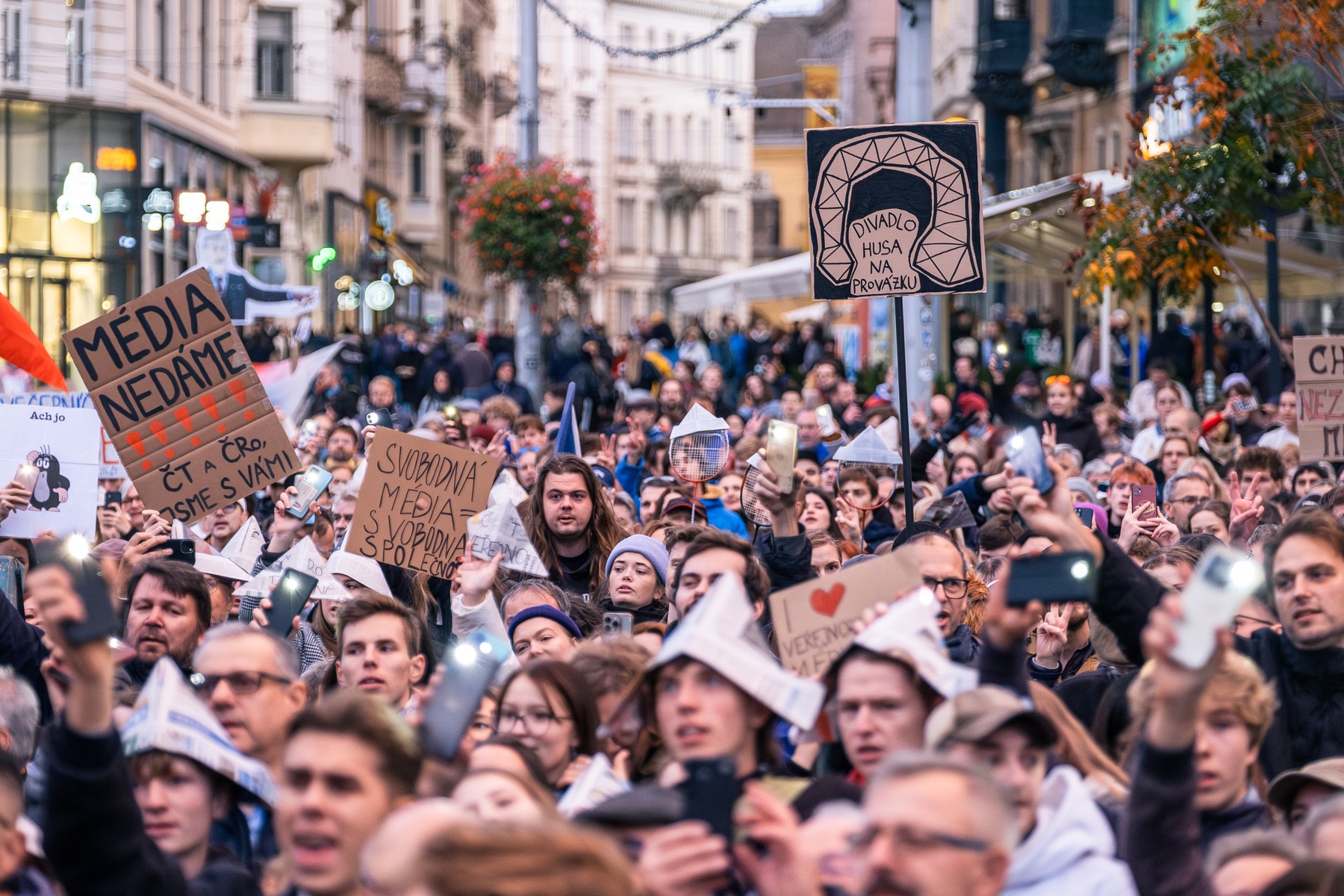
The government's plans to change the financing of Czech Television have provoked a stormy public reaction. Currently, they have culminated in strike broadcasting by public service media. It's not an overly harsh strike, especially when compared to protests in France. What if Czech Television deployed communist programmes instead of the mega-popular entertainment show StarDance?
When one hears about strike broadcasting, one would expect a black screen accompanied by reading statements somewhere in tracksuits by sleeping bags at Kavčí hory. Czech Television protested somewhat similarly during the previous attempt to limit its significance in the Czech media landscape.
This time on ČT 2, documentaries are running as usual, on ČT 1 horrible television productions from the times of the previous regime, which are being broadcast so that the television with a realistically declining budget can save money, and on the news channel ČT 24, which is the greatest nightmare of government politicians, retro reports from the times of socialism and the wild nineties are running. For nostalgics, an almost ideal viewing experience.
The Current (Non-)Strike at Czech Television
"One would think that shutting down news broadcasting at Czech Television in the interest of part of the political spectrum, which is the cornerstone of public media service, is quite a serious matter. But I actually find the replacement content quite entertaining. Actually even more than the standard one,"
wrote, for example, Minister of Sport without portfolio Boris Šťastný from the Motorists party on X, sharing a picture of a socialist kitchen. If such a kitchen were preserved in someone's apartment, it would certainly make it almost unsellable.
**embed:<blockquote class="twitter-tweet"><p lang="cs" dir="ltr">One would think that shutting down news broadcasting on Czech Television in the interest of part of the political spectrum, which is the cornerstone of public media service, is quite a serious matter. But I'm actually quite enjoying the replacement content. Actually even more than the standard one. https://t.co/b2C5v5CxJa</p>— Boris Šťastný (@borisstastny) <a href="https://x.com/borisstastny/status/2117498593573515592?ref_src=twsrc%5Etfw">November 3, 2026</a></blockquote> <script async src="https://platform.x.com/widgets.js" charset="utf-8"></script> **
There is no doubt that retro programs are meant to draw attention to the real decline in television funding through the proposed changes, which may be more problematic than the shift from license fees directly to the budget.
We have been seeing for some time now that Czech Television is saving money as a producer. The strike broadcasting thus suggests that this is the direction its production would take. People like Boris Šťastný probably wouldn't mind that too much. However, there are more fundamental issues in the background than audiovisual archives from socialism.
The state already has record debt deficits and with the termination of fees the debts will continue to grow, and worse still, interest rates along with them. Therefore, in reality, public service media will receive less money, but citizens will pay more. Don't take it!
We can see how mass transfers of public funds towards debt turn out today in footage from France. Young people suffer from high unemployment, schools are being cut, but there's nowhere to take it from, because there was massive borrowing for social benefits for over 10 years. However, attempts to reduce the generous welfare state (read: raising taxes) are politically difficult to pass and a political crisis is emerging, where France is unable to form a functional government and extremism is growing from both left and right.
That extremism which smashes shop windows, sets cars on fire and occasionally has its hand blown off by a police grenade. Something will have to be done about the debts sooner or later and we'll see how good Czechs react to them in the streets. After all, as soon as Petr Fiala squeaked about the need to save, people also took to the streets.
Clouds are gathering over StarDance
Everything didn't exceed the aggression of vulgar expressions, spitting or childish shoving matches. Whether we're talking about past strikes or the current one in the name of public service media. However, if government politicians continue to mock the television strike, its employees may also resort to an extreme solution.
"If some technical error could prevent Stardance from airing today and Babiš would kill that proposal by Sunday. If anything ever scared him in connection with Czech Television, it was finding out how much his voters love Eben and Kostková. He's still making fun of the demonstrators, the (non)strike in broadcasting is not enough," warns political commentator Martin Bartík on X.
Boris Šťastný with his little-car gang would certainly find an opportunity to make fun of something, or how to engage their puberty-stricken voters with some spicy vulgarity. After all, they settle for little. They're playing for their 5% in the Chamber of Deputies.
However, Prime Minister Andrej Babiš is playing for much higher stakes, and among the considerably more numerous ranks of his voters, we can also find those for whom an occasional crude joke is not enough to cast their vote. On the other hand, they like to watch StarDance on Saturday. The ANO movement also repeatedly reminds that the entire reform will not result in the cancellation of Večerníček or the obligatory dance show.
However, what will (not) air on screens is not decided by the governing party - legislation is there for that. We'll see who ends up on the longer side of the rope.
Sources: author's text, commentary, ČT, Manipulátoři, X