I want to build 500 apartments annually. The debate with flat-earthers taught me that when someone is convinced of their truth, it's hard to convince them otherwise, says Adam Scheinherr

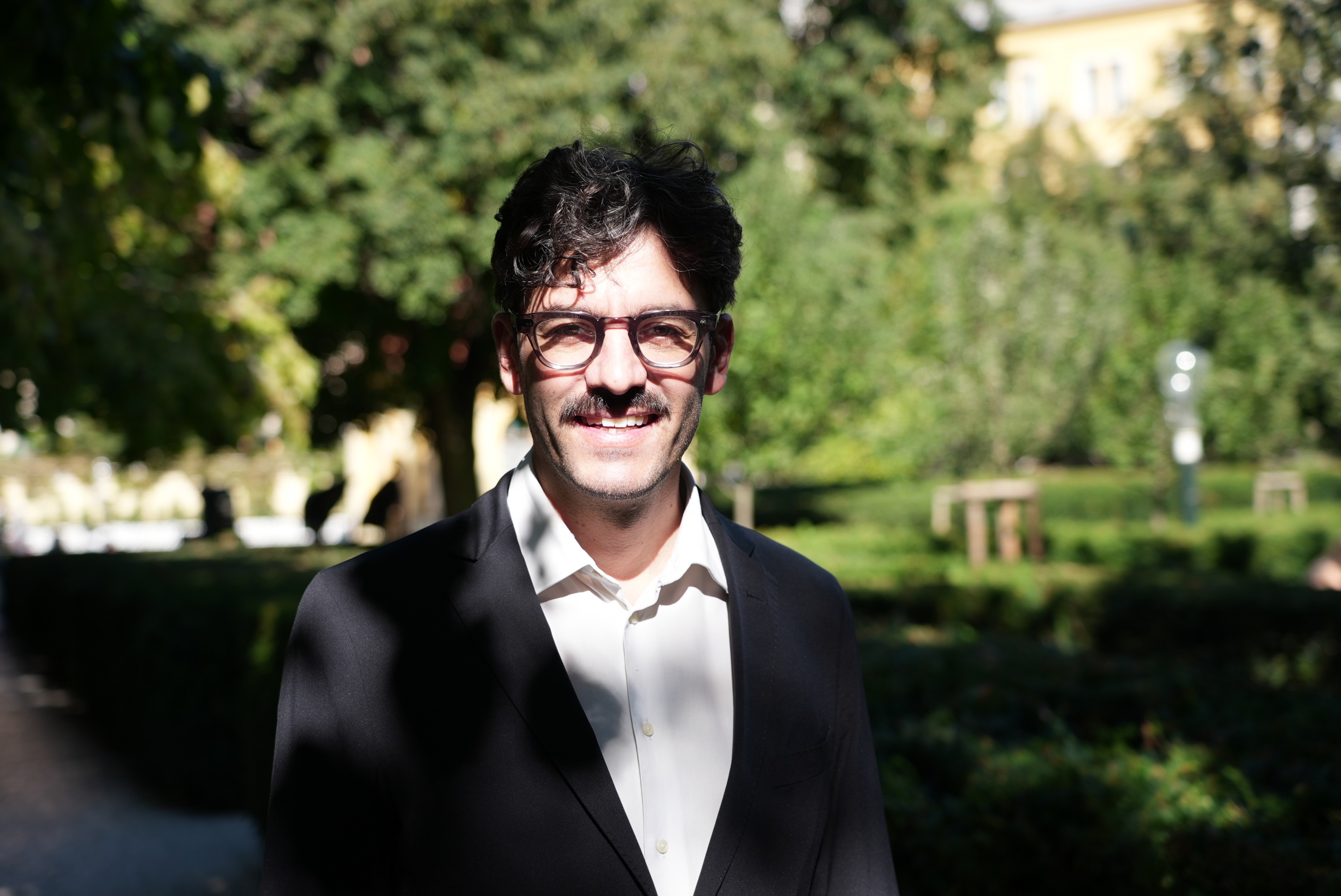
A mechanical engineer, manager, physicist, and politician – all of this is embodied in thirty-nine-year-old Adam Scheinherr, who is running for Prague mayor in this year's elections. We meet in front of the Franciscan Garden, where he arrives on a bicycle. In the past, he served as deputy mayor for transport, and since 2024 he has been the chairman of the PRAHA SOBĚ party. What does he think Prague should look like in five years? How does he evaluate his experience from his previous job, when he transported nuclear material in Georgia and Nigeria? What steps would he take to improve housing affordability in Prague, and what does he think about the increasing number of cycling paths?
We are right now in the Franciscan Garden. Do you have any connection to this place? What do you like here?
It's such an oasis of calm in the city center, right by Wenceslas Square. At the same time, one of the few places where there is greenery here in the center. And at the same time, I use it many times when I'm rushing somewhere in the city center, so I can easily shorten my route here. Because we are located in the interior block between Wenceslas Square and Jungmann Street.
What's interesting about you is that you combine politics and physics. You even transported nuclear material, in Georgia and Nigeria. What does that actually involve?
It's a huge responsibility. Actually, whatever you do, you have to have it calculated and you have to know what you're doing. Basically any movement of your hands. And it gave me a tremendous amount, because of course it was a very interesting job. But at the same time it was with some purpose – to reduce the nuclear threat. So I was very glad that I was doing something that had a good background.
Following up on the previous question, do you yourself know what the production of an atomic bomb actually involves?
Well, I wouldn't be able to make one myself, but generally I have a sense of it.
What do you think is a bigger adrenaline rush? Working with nuclear material, or politics here in Prague?
Transporting nuclear material is probably a bigger adrenaline rush. But here I think it's more about stress.
And do these two areas have something in common?
In both jobs, a person is incredibly busy and under pressure. And basically, in this regard, it's also good training.
Let's talk about Prague then. When someone says Prague, what comes to mind first and what do you actually like most about Prague?
When someone says Prague, it really warms my heart. I'm aware of the Prague panorama. Our greatest metropolis, beautiful Prague of a hundred spires, which has a story in itself and in every street. Especially when we're here in the city center, so some history. And actually, that's why I threw myself into politics here in our Prague. That I became interested in my surroundings and in what's happening here. And I wanted to contribute to Prague transforming following the example of Western metropolises. Regarding street reconstructions, the return of trees and also culture, social affairs and so on.
You personally live in Prague 7, what do you personally like about this district?
It's close to the river and the river is actually a gift of our city. So I really love that. At the same time, I have everything accessible there. And whenever I go for culture, I can easily travel around the whole city. There's also a train station, there's a metro line and there are accessible kindergartens, because the town hall in Prague 7 takes care of that. And overall I'm satisfied there.
Is there something you would change instead?
I think that many streets there deserve reconstruction and the return of trees. At the same time, there's a main road passing through, which creates a lot of transit traffic.
Do you remember your very first apartment in Prague? What did it look like back then and how has your idea of good housing changed over time?
I lived there with friends, still in Prague 4. It was probably common that when someone is studying or starting to work, they have roommates. Now I live with my wife and son, so we already have our own apartment that we're paying off with a mortgage. And back then, rents and apartments for purchase were definitely not so expensive. Today, the situation has actually changed incredibly. After 2014-2015, prices began to rise steeply.
That's another topic I'll open up. Because Prague is today a city where people can afford to work, but not necessarily to live. Where do you think Prague made a mistake in this area in recent years?
Prague in the 90s had 200 thousand of its own apartments, which it sold off mainly during the ODS era. And thus Prague as a city doesn't have its own capacity at all to have apartments for needed professions, for social purposes, for the handicapped and others. At the same time, it fell behind in building or constructing its own capacity. And at the same time, we had such a complex zoning plan that basically required an amendment for every new development. Under various politicians, they were slowed down and took maybe 4 to 8 years, which is actually an incredible amount of time. During that time, you can't even prepare the actual construction, the actual project, and you're just waiting for one stamp of approval until the council approves it here.
So should Prague rather build affordable rental housing, or focus on creating good conditions for developers?
Definitely both. We need to build, we can even buy from developers ourselves, but we won't save the market on our own. My goal is for us to build 500 apartments per year, but Prague needs around 10 thousand apartments per year. That means 9.5 thousand will remain for developers.
In an ideal case, what proportion of those new apartments should belong to the city?
Well, precisely something around those 500 out of 10 thousand, so that's 5%.
When we look into the future, how do you think Prague should look in, say, 10 years, so that it's a good place to live for someone who is planning to settle here and start a family in Prague?
I imagine that Prague will have around 10% of housing stock. Every street will have new tree-lined avenues planted. So that in summer, trees can help us cool the streets by up to 6°C this summer. When it was, say, 41°C and suddenly you have 35°C, it's actually a huge difference. At the same time, construction of the fifth metro line, the circular metro O, will begin. This will be the first metro line that won't come radially into the city center, but will serve the city districts around the center, and thus we'll actually gain a new fast mode of transport.
And at the same time, I hope the state will build high-speed rail lines and we'll become one of the true European metropolises and that trains won't bypass us, but will come here. And I think that for all these projects, we don't need to look far. It's enough to look around cities like Vienna, Zurich, Barcelona and draw inspiration there and actually copy those projects from there. I always say that we're about 10 to 15 years behind these metropolises and we don't need to invent anything, it's enough to take the good things.
Going back a bit, a lot of people are moving to Prague for work. So the question arises, what if some large, important institutions were moved to a city other than Prague?
I don't think it's really about that. Today, some institutions are already based in Brno. There's even an energy authority in Jihlava. But I think that building high-speed rail lines, for example, will help tremendously. This will allow people to live in places like Pardubice and suddenly you'll get here in fifteen minutes. And the distances will change incredibly. So you'll be able to live in a different regional city, for example, and commute here for work. It's more about providing the infrastructure so that citizens can be easily mobile, so that it's fast, comfortable, convenient, air-conditioned and so on.
You've already touched upon many steps to improve the situation in Prague. However, if you had to do one single thing as mayor that would improve housing affordability in the next five years, which one would you choose? What would it be?
Well, metro O. Although it's not for the next five years, metro O is meant to serve all development areas from the north through the east to the south of the city. And that will actually support construction in these areas. And some of them are in the hands of developers, but there's for example the Bohdalec and Letňany area, where on the contrary the city is supposed to build, it has land and up to 25 thousand people are supposed to live there.
You said that Prague is about 10–15 years behind other metropolises. So can Prague be considered a smart city today, or are we not quite there yet?
I think we have a lot to catch up on here. Brno has even overtaken us in this, and I think that Prague, given how many universities, research institutes and various companies are here, has the potential to truly become an innovation hub of Europe. But we also need to support it from Prague's side. Support cooperation between Prague and universities and at the same time connect them with the private sector, give them the facilities for it. There's a lot of talk now about the reconstruction of the Strahov dormitories. The city also has land there, it has the Strahov stadium there. I would somehow connect it all and use that stadium. For a long time we actually didn't know what to do with it, and here's an opportunity for it to be a facility for an innovation hub. At the same time, culture and sports can take place there and mix everything together.
We mentioned that you live in Prague 7. Which Prague district would you recommend today for someone looking for housing, aside from Prague 7? And why?
Every district certainly has something to it. Now when I'm touring the whole city with my bus during contact campaigns, last weekend I was in Dolní Počernice, for example, and there you actually have, I would say, an oasis of peace. People live there in family houses. And from Dolní Počernice you can easily get by train to the city center in just a few minutes. So for example, I'm now inspired by Dolní Počernice, where new construction will take place. The city will also be building its municipal houses there. So I recommend it.
You came here with us today by bike. Cycling has also been a big topic in Prague lately. My question is, aren't there too many bike paths here? Doesn't the situation require some solution?
Well, the best thing is to build separate infrastructure from cars and from pedestrians – so that cyclists don't get in the way. But we are a historic city and especially in the city center the streets are too narrow for us to fit all modes of transport there. And I think that on the contrary, cycling infrastructure should increase, so that those who want to can ride a bike and can get where they want to go safely. And unfortunately, that's not possible in Prague today. And in this regard, we are again behind those Western metropolises.
You are in an internet project called CzeXperiment with people who believe in flat earth. What has this debate taught you about people, what can you perhaps apply in politics?
It taught me that when someone is convinced of their truth, it's very difficult to convince them even with arguments. And this happens day in and day out in politics. And with the declining significance or readership of traditional media and many people drawing information only from social media from their favorite profiles, I think this ability to spread disinformation has become much easier and is even somewhat dangerous for me.
Thank you so much for the interview.
Thank you very much too.
Source: author's questionnaire