Havel's Benches stand from Washington to Hiroshima. This year another one will be added in Prague
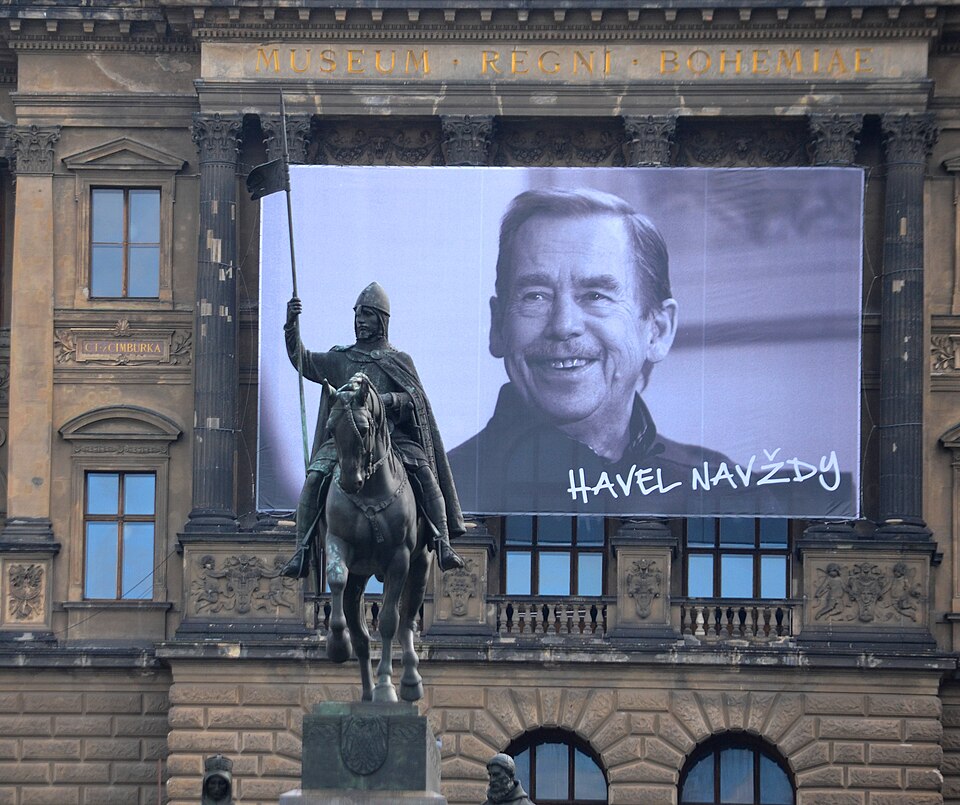
He has an airport, a square, a library and a theatre named after him. Yet one of the most famous tributes to Václav Havel has become a simple bench. And that's because it corresponds to who he was. A safe place for exchanging views. And what else can you look forward to during this year's celebrations of the former president's would-be 90th birthday?
Mariánské Square will belong to Havel
The main Prague celebrations will take place on September 21st at Mariánské Square. From morning until evening, there will be readings from Havel's texts, debates, concerts and other activities commemorating his life and work. The most important part of the program will come at three o'clock, when a new Václav Havel Bench will be ceremonially unveiled under one of the lime trees. The celebrations will also be attended by Dagmar Havlová and other iconic personalities. Furthermore, agreements of organizations will be presented that will take care of Havel's literary, philosophical and social legacy.
Prague Mayor Bohuslav Svoboda, when announcing the event, reminded that Havel remains present not only in memories, but in the values he left behind.
"On Havel's Bench, people can sit next to each other, talk together and listen to one another. I think that is exactly what would be close to him," he said.
In the evening, Aneta Langerová, the Czech Radio Choir, Leona Machálková, The Plastic People of the Universe and the band Svatopluk will perform in the square. The atmosphere will be complemented by a light installation by artist Michal Škapa and an outdoor exhibition Prague of Václav Havel, which will remain on site until the end of October.
From Stagehand to Prague Castle
Havel's life story would make a great film.
His origin made it quite difficult for him to pursue his studies after February 1948. Before his name appeared on theatre posters, he hauled stage sets at the Theatre Na zábradlí. That's where his dramatic career started, which later crossed the borders of Czechoslovakia. After 1968, however, he found himself on the list of banned authors. Havel's dramas still grace the lists of selected literature for graduation exams at multiple schools across the Czech Republic.
Then came the years when he increasingly vocally opposed the communist regime. He was among the first signatories of Charter 77 and was imprisoned several times for his views. When he was elected president of Czechoslovakia at the end of 1989 after the Velvet Revolution, for many people it symbolized how fundamentally the country had changed in just a few weeks.
The journey from banned author and political prisoner to Prague Castle is one of the most powerful stories in modern Czech history. And also one of the reasons why Václav Havel is still known and respected far beyond the borders today.
Ferdinand Vaněk's Bench Will Commemorate Havel in Ostrava
An interesting program is also being prepared in Ostrava. In front of the prison in Heřmanice, where Havel was imprisoned during normalization, a commemoration will take place connected with Ferdinand Vaněk's Bench.
Vaněk was a character from Havel's plays and at the same time his literary alter ego. Visitors will be able to view, for example, an installation inspired by the letters Havel wrote from prison, a plastic bag full of ordinary things.
A place that was a symbol of state repression will thus be transformed for one day into a space commemorating freedom, civic courage and the power of perseverance.
A Czech idea that travelled around the world
Václav Havel's Benches today stand in several dozen places around the world. They were designed by Havel's long-time friend, architect and designer Bořek Šípek.
Their design is simple, two chairs connected by a round table with a tree growing through the centre of the table. The purpose was not to create a monument, but a place where people stop and talk together.
The first bench was created in 2013 in Washington. Others can be found in Dublin, Oxford, Barcelona, Brussels, Paris, Vilnius, Geneva or Hiroshima. In the Czech Republic, they stand in Prague, Brno, Plzeň, České Budějovice and Hradec Králové.
While others have monumental statues built for them, we remember Havel with a bench where two people can sit and chat in peace.

Havel is remembered beyond borders too
The anniversary will not only be commemorated in the Czech Republic. Events connected with Havel are also taking place abroad, where he is still perceived as an important dissident, playwright and defender of human rights.
His name is borne by international prizes, university programs, and public spaces. This year, for example, commemorations began in Avignon, France, with the premiere of Havel's unfinished play Lilac.
Abroad, Havel is often remembered primarily as a person who managed to connect the world of culture, civil society, and politics.
A Legacy That Is Still Visible
This year's anniversary is not just a remembrance of the former president. The program in Prague, commemoration in Heřmanice, and events in other countries show that Havel remains part of the public space even fifteen years after his death.
And perhaps it's no coincidence that the main symbol of the celebrations is not a new statue or memorial. But a bench. An ordinary place where people can sit down, pause for a moment, and strike up a conversation.
Václav Havel would probably recognize himself in that.
Sources: author's text, vaclavhavel.cz, havel90.cz, Wikipedie.cz, prazske-noviny.cz