Whoever gives 90 million to the campaign will be in the Parliament, says nineteen-year-old politician Daniel Krutý

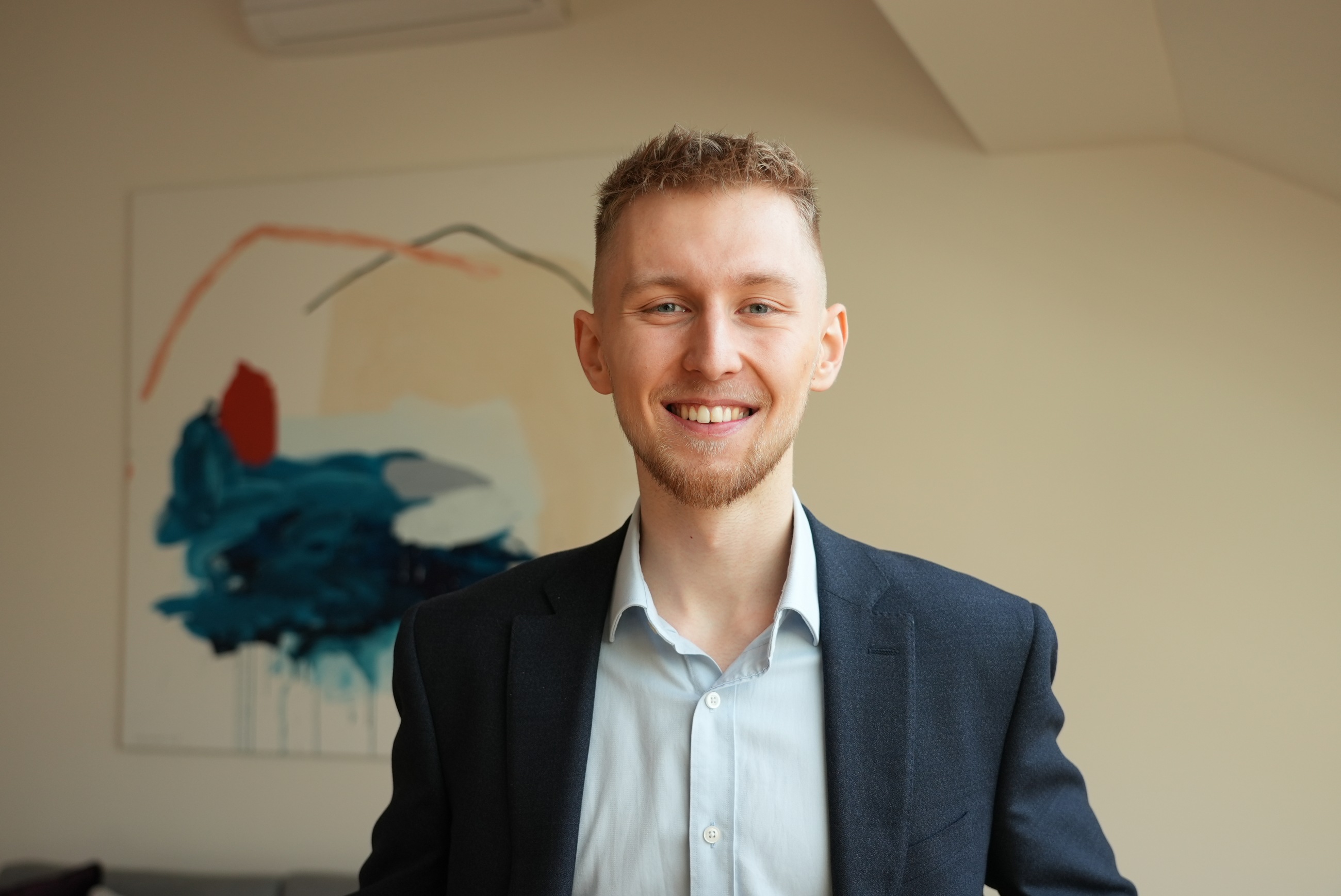
What steps can be expected from the future government? How does Daniel Krutý perceive the scandals surrounding Filip Turk? Is it important for him to own property? Should we continue to support Ukraine? And does he see a security risk in the form of an attack by Russia? Not only about this we talked in the latest interview with the only nineteen-year-old politician and leader of the Generation Movement Daniel Krutý, where we reflected on the election results.
We are relatively fresh after the elections. I've read some of your posts on social media where you reflected on the results of your political group. So I wanted to ask, how satisfied are you with those results?
Thank you once again for the invitation. We are quite satisfied. Considering that we ran the campaign honestly, fairly, without money. We didn't really have any special project management. It was a bit of a punk project. And we went headfirst into it. So the result is actually quite nice. We are ninth, right behind Přísaha. We didn't have billboards. That means, we are satisfied.
We have worked hard, however, we have an even bigger piece of work in the future. But quite, I would say, a good starting line.
When we look at the overall results of these elections, what do you think this tells us about the current political climate and the overall social mood?
Absolutely, I would say, politically precise, that kind of societal fatigue from the crisis, which is here. Or from those crises that have accumulated over the past five years.
This means that there was one significantly dominant theme here - anti Fiala, which just worked, so the government changed. And people want a little bit back from those reforms. Everything to everyone. The state will dig up the money somewhere, the politician will arrange it somehow.
This reliance on the state is even more dominant now. And of course, I am happy that the communists did not get into parliament.
The governing coalition, which will govern, will be a government of missed opportunities, because important reforms will be stopped again.
Were you surprised by the election results, or did you rather expect them?
I rather expected them. When we were campaigning and went outside of Prague, nobody really wanted Petr Fiala's government anymore. There you could really see the anger and disappointment in people. In the end, when you have a large block of your non-voters against you and you disappoint your own voters - by not completing some reforms or saying about a 10.86 billion deficit that it is exceptionally responsible management - then it just turns out bad.
So I don't know what they were expecting. It's a pity, but at least there's room for new entities like us, so we'll see.
When I return to that post, I still felt a bit of disappointment. If you were to go back and evaluate the situation retrospectively, what would you perhaps do differently?
That's actually a great question, I've never thought about it like this. One should try to reflect some of his impact, retrospectively evaluate it within oneself.
Of course, we made mistakes, but we take it as some lesson learned. And if I have to give you a specific example, we shouldn't have had that hiatus of about two months, where unfortunately no video came out a few weeks before the elections. That's a pity. Then we were catching up, but given that we were also raising some money, there was some fundraising and we tried to do something a little different than politics and did a lot of programming, so we underestimated the external presentation.
This may be something we can focus more on next time.
And I'm interested, you've mentioned it or hinted it - the finances. How big a role does it play, how much money is put into the campaign?
Absolutely crucial. In politics, it doesn't matter what the electoral program is, you can write anything there. The important thing is for people to see you and to feel that you are the right politician for them. So if someone runs a permanent campaign and puts 90 million into it, it's almost certain they'll be in that parliament.
According to a survey by the STEM organization, the decisive topics were security, health care, and finance. In connection with this, I wonder if you have considered that in the future it will be necessary to change the priorities of your program. Or will you not touch it at all and it will remain as it is?
I would certainly not claim that we will not touch it at all. I think that political parties, which are locked in the idea that only one topic is important and do not allow anything else, have a bad strategy. There will certainly be some changes, but rather we will respond flexibly to the situation that arises. Because I still think that public finance will be the central theme.
The more this government is planning to repeal the pension reform, raise salaries, raise allowances and raise contributions, the more we will then have to consider the horizon of sustainable public finances. And I think there's still room for us to improve in this country. So it will still be a viable theme of that program.
You mentioned pension reform. What can we expect from the future government in this regard by your opinion? You talk about the pension reform in the media quite often.
We can expect the cancellation of the pension reform, which means we can alter, reform, adjust those systems to the image of a politician. However, what we should avoid is an adamant rejection of everything, cancelling, stamping: "No, I do not like it, I do not want to do it, I as a politician absolutely do not need this reform" - which is short-sighted.
Of course, it is not that simple, because even though the government capped the retirement age at 65 years, which is now the main point of the program declaration, nothing will happen during Andrej Babiš's government. The whole increase in the retirement age was planned only from 2030. That means that Babiš will change the number in the law, but the retirement age will continue to increase by two months each year.
It is therefore a vague statement, but if they also declare that they want long-term balanced budgets, cancelling the pension reform is against that. In the horizon of 50 years, it will cost us millions of crowns, which are lacking in investments, in science, infrastructure, and energy.
Cancelling the pension reform is simply a step back. It might be tolerable if they did it differently - for example, maintain the first pillar with retirement at 65 years, but also introduce fund financing and the second pillar, so that everyone could invest for their pension and thus increase personal responsibility. But they just say "cancel, cancel, cancel". And some parameter changes to the third pillar unfortunately aren’t enough.
Among other things, Andrej Babiš stated that we will not send even a penny to Ukraine. How do you evaluate this statement?
I think it's wrong, because Andrej Babiš is a non plus ultra politician. What he says before the elections is not taken as hard currency, but he has an electorate, voters, who do not support Ukraine, and therefore it is a logical conclusion to his program. Nevertheless, I think it's wrong.
Even though the situation is long, many are already annoyed; some citizens have had bad experiences with Ukrainians in the Czech Republic. But these are people who have fled from a country where rockets are falling, and it is right to support a country that is defending itself.
Let's be clear: if there was a war in the Czech Republic, surely a lot of wealthy people, who have beautiful cars, would run away, because they do not want to risk their lives. I don't like labeling; there are violent people among all populations, including Czechs.
However, I think this is now a sensitive issue, which has been unnecessarily politicized. I understand that it is about internal security and trying to prevent an increase in crime, but in my opinion, helping people who are fleeing from the war is the right thing to do.
Vaclav Klaus stated in one of the interviews recently that he finds it comical to think that Russia would attack the Czech Republic. How do you perceive this current security situation, if Ukraine really fell? Is there a certain risk that Russia could attack the Czech Republic?
One advantage of authoritarian countries is that they usually strategically prepare their citizens for what's to come in the long term. This can be validated by the fact that before the acute phase of the war campaign in Ukraine, Vladimir Putin and the entire regime were claiming long-term that Ukraine is full of fascists, subhumans, and that there are Banderites, who are killing people. They were preparing the population for the invasion.
What does it do now among our allies? If you watch Russian state television, they regularly talk about going to Warsaw and Berlin because there are fascists in the west who are destroying the economy. I hope that doesn't happen. And I don't think it will. But I definitely won't rely on it. It is important to invest in internal security and defense to deter the aggressor. That is fundamental.
Of course, Daniela, I must ask you about the current cases of Filip Turk. There are many of them now. How do you perceive that? Should such a person be foreign minister?
Certainly not, certainly not. Of course, there are a lot of emotions there, the media and people don't believe it, and now various conspiracy theories are emerging.
Even if everything that Deník N came up with was a lie – let's suppose, none of it's true, even though I don't think so – what Filip Turek has not yet deleted from social media and what he admitted in the past is enough.
For example, the statement that he wrote on social media "Kellner to the gas". And when Ms. Bobošíková asked about it at the time – it's quite funny that some kind of revelation happened in this show –– he said that he doesn't remember it well and he was young and stupid. No, that's wrong. He wrote it when he was 25 – I'm 19 and in my opinion I wouldn't write such a thing even at 13 – just such a scandal. Such a person does not belong in the Ministry of Foreign Affairs.
I have one more important argument: consider what has come out about him or what emerges when he was targeted by the media and ordinary people.
Now consider that such a person will be a government minister and will be targeted by security services, some foreign powers, some foreign states. What else will emerge about him? What will be the blackmail potential on Filip Turk? What else will they find about him? There are simply many questions and few answers, and unfortunately such a person has no business in the foreign affairs ministry.
We still don't know exactly who will take up each ministry. How do you evaluate the potential government composition? And what would you say to Andrej Babis if you were the president?
It obviously depends on what he would come up with, but the president has an important role because the constitution speaks of the fact that he appoints and dismisses prime ministers and members of the government, which are then variously interpreted within the law.
What would I say about the cabinet composition? These are mostly people that Andrej Babis does not accept. We will find there former employees of Agrofert, we will find there experts from SPD, who are people who once cooperated with Andrej Babis. The same goes for Boris Šťastný - a person who, if he had relationships to ODS, is then of course close. So Andrej Babis composed it nicely.
The next topic I would like to discuss is the housing crisis. Andrej Babiš announced in relation to this topic that he wants to build ten thousand flats a year. Do you think that's realistic? And what else can we possibly expect from this government, what steps will it take?
As for the housing section, I think that realistically it is probably possible. Of course, it depends on what instruments he will choose for it. If he wants to change the building law and facilitate the building process, then in general let's say that it's a good intention, and let's be glad that the government will do it.
On the other hand, I believe that many steps she takes – when I deviate slightly from the topic of housing – will mean lower prices. And how? Well, the state will pay for that. So just like in the end, whether I pay directly as a citizen through an invoice, or whether I pay it through my taxes through the state budget, it doesn't matter at all.
Because if the state pays for me, it still has to take the money from somewhere. And it takes it out of my pocket. So, unfortunately, a lot of people probably don't realize that.
Of course, when there is still that debt, our children will pay for it. No one asked them, so I feel a bit bad about it. Especially for some regular operating things, let alone subsidies. So that's a shame.
But as for housing, we have a mismatch of demand and supply in the market. The state pumps about 30 billion crowns into it every year and more should be built, I agree with that. But now maybe people will argue with me, but it's not about a lack of apartments on the market, but about them being expensive.
Whoever wants to live can live. We are in a beautiful room, so one can afford to buy it, but we need to make housing more accessible. To make it cheaper, to provide social housing, to simplify the permitting process - so that is now a fundamental task in front of the government. Let's see how they cope with it.
I'll keep my fingers crossed for it, of course, but we shouldn't forget about the long-term horizon of the policy. Always, strategy, it has to be a vision.
You are 19 years old, do you plan to take out a mortgage in the future? Do you think it will be achievable for you? Or should we perhaps prepare for a change in the concept of living in the Czech Republic and rent will prevail, as it is in other countries in Europe?
That's a good question, if I'm considering a mortgage. Probably yes.
The question is rather whether, as a young person, it is important for you personally to own real estate?
I no longer completely belong to the generation that necessarily has to own something. For me, it would be more comfortable, pleasant, but I honestly tell you that rather than investing in bricks, I prefer to invest in some stock market. Quite honestly, as a person with a bit of economic background.
On the other hand, it is always more pleasant, there is some certainty. And a person needs some outlook and certainty for their own self-development, so probably yes, but it's not something I would insist on, that I have to have my own housing. Renting is completely fine.
Julie Smejkalová has just made it to the Chamber of Deputies, and part of the public started criticizing her for being there at this age. My question is, how do you perceive this and whether we have enough young people in the Chamber of Deputies, like yourself. Even though you could not yet enter the Chamber of Deputies (it's possible from the age of 21, editor's note).
I understand the question. The average age in the Chamber of Deputies is still around 50, I guess this won't change much with the new composition, even though we have a historic number of people under 30 there.
But now I might surprise you, I wouldn't focus too much on having a lot of young people, I would mainly want competent people there. Because a person is sometimes ashamed for many young colleagues in politics, sorry, but that's just the way it is. But I think we need capable people. Those young people can bring new perspectives, of course.
I think it should reflect the composition of the generation of this state. Now it is slightly biased towards the older generation, we see it in election programs and in the electorate - if you have 2.4 million older pensioners, they will probably become a priority in the elections, right? So you have 2.4 million voters.
But when it comes to the last three years, while everyone keeps talking about how it should be, I'm trying to change it. I'm trying to enter the public space, to bring solutions, something that few do in politics.
But, as I say, I'm rooting for Julia. We had a tiny dispute, she wrote something on social networking sites once and it has caught up with her now. A year ago, she wrote: "Mr. Krutý, on what grounds do you act as an expert on public finances when you are so young?" So I think that's interesting, I didn't expect that from you. And now it's catching up with her. I reshared it on Twitter again and she got a bit of heat there, but I think it's something a politician must go through. I wish her good luck, we'll wait for the work. This didn't go very well, let's say, but I'll stand up for her. It's not about age, it's about how capable one is.
What does that mean, what role does political experience play there in your opinion?
It's always good to have some experience, and it doesn't matter if it's from life or from politics. One must have some experience, but I don't think that politics is just about being experienced.
Politics has always been about listening, about the ability to adapt, find solutions to the problems that our country has. That's what politics is about and it's not necessarily about being 40 years old and having two mortgages around our neck.
You hinted at my next question earlier. As you mentioned yourself - the largest group of voters are people of retirement age. Isn't that a bit problematic in terms of programs often being determined by what retirees want, and younger people are somewhat sidelined? Do you think this will change in the future? How can we attract young people to politics in general?
Difficult question. We are trying to do this just by being here with you, thanks for the invitation. By being on networks and the like. Maybe some young person will see it and say: "Hey, that makes sense, maybe I'll support them in the elections."
However, the conglomerate of retirees here is really huge. It's not about dividing society - among older people, there are many who care about making the world good for their grandchildren.
But let's face it - it's an electoral group that is often promised something and they are very eager to go to the ballot box. There is a lot of manipulation with this and it is almost indecent. I don't think it's right in the sense that I have an extra 500 CZK pension. The important thing is that when something happens, an ambulance will arrive and the care service will have capacity. In 2023, 60,000 applications for admission to retirement homes were rejected - the capacities are not there. These are things where we should improve, not just blanket giving money to the elderly.
The population will age and the situation will worsen. If we now have 2.4 million older pensioners, there will be 2.8 million in 2060. Assuming retirement age will increase to 65 years then 3.2 million. This will be a tremendous pressure on the system and the state budget. Well, and this cannot continue indefinitely.
It may happen that even those who chose higher pensions will run into it, because if no one lends and The International Monetary Fund says: "Dear Minister of Finance, we are done." Pensions will be minus 20% and no one will ask anyone. Therefore, I warn that every crown we add to pensioners could be irreversible. Therefore, do not increase them now above statutory valorizations, because it enters into those other valorizations. Well, we will see what awaits us. But unfortunately, I am a bit sceptic about this.
When we remember, for example, the Pirate Party's campaign before they entered the Chamber of Deputies, they were perceived as a rebellious party, standing against traditional parties. Later, they were criticized for becoming the same bigwigs as politicians from traditional parties. My question is, isn't this something that can't be completely prevented - considering that political roles come with considerable benefits and high financial pay. Aren't you afraid that politics will spoil you over time?
I believe that a person who goes into politics not for the financial aspect, but who has skills and understands how public systems work, brings solutions and can stay afloat. We have candidates who are top managers, own companies or live normal lives and had no need to go into politics. But I'm thinking that selling this country for one's own comfort is not fair.
I believe that in order for me to be comfortable, but also for people not to be disappointed, we need to act responsibly. I can't promise that everyone on my team will be flawless, but we are trying to choose honestly and fairly. We will do everything to ensure our movement retains the character of a confident, likeable subject. We do not want money and power - we care about the program and solutions, not financial benefits.
We are doing it for the third or fourth year and we are learning. If it was only about getting into politics, we would have taken half the people. But we refuse compromises, because we don't want to do politics just for our own comfort.
Daniel, I wish you a lot of luck in the future and thank you for the interview. Take care.
Source: interview, own questioning